The Last Frame on the Roof
A free B2-level English story for language learners, readable online in 7 languages, with an option to listen via the free Storyteller app.
During a city-wide power cut, two neighbours improvise a way to take one long-exposure photograph with a broken tripod.
That was the preview! Hear the full story in the free Storyteller app. Get the app
Audio isn't available right now.
The power went out at nine minutes past eight, and the whole building seemed to take a breath. The refrigerators stopped humming. The lift groaned and went silent between two floors. Somewhere below, a baby began to cry, and a man's voice shouted that it was only a power cut, as though shouting would help.
Rui stood in the middle of the flat with his camera in his hands and grinned in the dark.
"This is it," he said. "This is exactly what I needed."
Safiya, who lived across the corridor, had known Rui since they were both small enough to share a paddling pool. She had warned him for years that a grin like that usually ended in trouble, and she had said it in many different ways. She came through his front door now, lit from below by her phone, and gave him a long look.
"You have your photography face on," she said.
"The competition closes on Friday," Rui said. "The theme is The City at Rest. I have one photograph left on this roll, and I have been waiting a month for a night this dark."
The camera was old and heavy, a metal film camera he had bought at a market for the price of a pizza. It had no screen and no way to take back a mistake. He had used thirty-five of its thirty-six frames on a school trip and on the cat. The last one was the only one that mattered now.
"A whole city with its lights out," Safiya said slowly. "You could see the stars from the roof."
"That is the plan. A tripod, a long exposure, the skyline and the sky together. Twenty seconds should be enough."
"Then I am coming with you," she said. "Somebody has to hold the torch."
They climbed the stairs by phone light, nine flights, with the sound of other people's doors opening and closing above and below them. The roof door was stiff, and Rui had to lean his whole body on it. When it finally swung open, the night poured in, cool and enormous.
Safiya gasped. Neither of them said anything for a while.
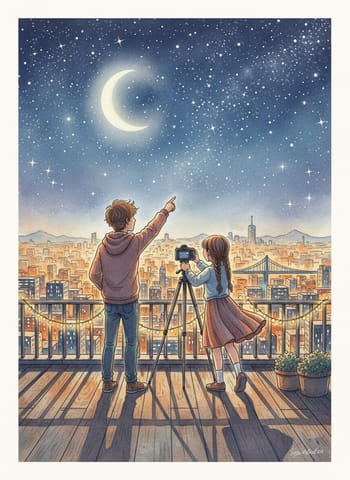
The city lay below them like a map that someone had forgotten to light. Where there were usually rivers of white and orange, there were only soft shapes. Here and there a candle moved behind a window. Above it all, wider than Rui had ever seen it, the sky was full of stars.
"Set it up," Safiya whispered.
Rui unfolded the tripod, a thin aluminium one he had borrowed from the school photography club. He had checked it twice that afternoon. He screwed the camera onto the top, pointed it at the skyline, and reached into his jacket pocket for the cable release. It was a small plastic button that opened the shutter without touching the camera.
His pocket was empty.
He checked the other pocket, and then his back pocket, and then every pocket again in a kind of slow panic. Safiya held the torch while he emptied his bag onto the roof.
"It was on my desk," he said at last. "I put it on my desk so I would not forget it."
"Can you press the button on the camera yourself?"
"Any shake at all blurs a twenty-second exposure. The stars would turn into little scratches."
Safiya chewed her lip. "Then we use the self-timer."
"The self-timer lasts ten seconds, and the shutter only stays open for a split second after that. It is the wrong kind of camera." He sat down heavily on the gravel. "I carried this thing up nine floors."
For a minute they said nothing. Then Safiya stepped forward to straighten the tripod, because she could not bear to watch it stand there looking pointless. One of its legs folded in half with a small, sad crack.
The camera slid. Rui caught it a few centimetres above the roof, with both hands and a sound that was not quite a word. The tripod lay on the gravel like a broken umbrella.
"I am so sorry," Safiya said.
"It was always going to break," said Rui, breathing hard. "It belongs to the club. It has been broken for three years. I think I knew."
He stood there holding the camera against his chest, the last frame still waiting inside it, and for a second he honestly considered going home. Then Safiya started walking along the edge of the roof, looking at things.
"What is the problem?" she said, mostly to herself. "You need the camera to stay still. You need the shutter to open and close without you touching it. Those are two different problems."
"Thank you. That is a clear summary of my evening."
"So we solve them one at a time." She tapped the low brick wall that ran around the edge of the roof. It was about knee height, flat on top, and covered in a thin layer of cold dust. "Here is a tripod that has never been broken in its life."
Rui looked at the wall. He took off his jacket and folded it into a thick pad, and he laid the pad on the bricks. When he put the camera on top, it pointed too far at the ground. Safiya dug a coin out of her pocket and slid it under the front of the lens. The camera tilted up to meet the skyline as though it had been waiting for this all along.
"One problem down," said Safiya. "Now the shutter."
"This dial has a T setting: one press opens the shutter, and a second press closes it. But every press moves the camera."
"Then press it only twice, very gently, and keep the lens cap on for both. Press once now, while the cap is on." She held up the black plastic cap. "Then we take the cap off. We count to twenty. We put it back, and you press again. The cap is your shutter."
"That is not how professionals do it."
"No," she said. "It is how two people on a roof do it."
It was ridiculous. It was also, he realised, exactly the kind of idea that people write down in books. Rui pressed the button with one finger as softly as he had ever done anything, and the camera clicked. The lens was still dark behind the cap. Safiya took her position with the cap in her fingers, and Rui crouched beside the wall and held his breath.
"Ready?" she whispered.
"Ready."
She lifted the cap away, and the lens drank in the night. Safiya began to count, quietly, in a voice made of nothing but air. "One. Two. Three."
At nine, something happened to the horizon.
A line of light appeared in the far distance, thin as a hair, and began to spread. It ran along the river, jumped a bridge, and bloomed across an entire district in a single trembling wave. Streetlamps lit up in rows. The city was waking up, one neighbourhood at a time, and the wave was heading straight for them.
"The power," Safiya breathed, still counting. "Rui, the lights will ruin it. Should I cover the lens?"
For a long moment Rui could not speak. He thought of the stars, which would fade as the glow rose. He thought of the empty, honest darkness he had waited a month for. Then he thought of a line of light running across a sleeping city like a spark along a fuse.
"Do not cover it," he said. "Keep going."
"Ten," said Safiya. "Eleven. Twelve."
The wave crashed into the streets below them. The building shuddered, and the lift, nine floors down, began to hum. The stars were still there, but fainter now, framed by a skyline that glowed.
"Eighteen," Safiya whispered. "Nineteen. Twenty."
She slid the cap back over the lens. Rui pressed the button a second time, so gently that the camera did not tremble. The shutter closed. The last frame was finished, and somewhere in the dark of the metal box, the whole glowing city was waiting to be developed.
Rui let out a breath he seemed to have been holding for a month. Then he picked up the broken tripod, tucked it under one arm, and followed Safiya toward the stairs, where the lights were already coming on.