The White Hare and the Crocodiles
A free A2-level English story for language learners, readable online in 7 languages, with an option to listen via the free Storyteller app.
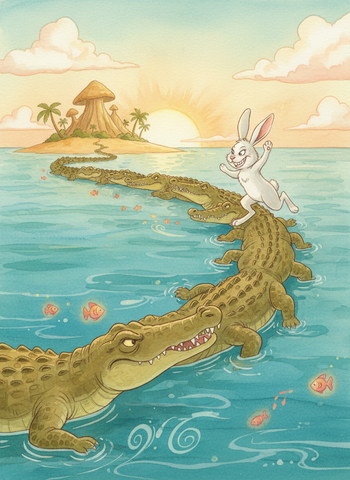
A clever hare tricks a crocodile into forming a living bridge across the sea — but mocking his helpers proves a costly mistake.
Long, long ago, when all the animals could talk, there lived in the province of Inaba in Japan, a little white hare. His home was on the island of Oki, and just across the sea was the mainland of Inaba.
Hace mucho, mucho tiempo, cuando todos los animales podían hablar, vivía en la provincia de Inaba, en Japón, una liebre blanca pequeña. Su hogar estaba en la isla de Oki, y justo al otro lado del mar estaba la tierra firme de Inaba.
Now the hare wanted very much to cross over to Inaba. Day after day he would go out and sit on the shore and look longingly over the water in the direction of Inaba, and day after day he hoped to find some way of getting across.
Pues bien, la liebre quería muchísimo cruzar hasta Inaba. Día tras día salía y se sentaba en la orilla y miraba con anhelo por encima del agua en dirección a Inaba, y día tras día esperaba encontrar alguna manera de cruzar.
One day as usual, the hare was standing on the beach, looking towards the mainland across the water, when he saw a great crocodile swimming near the island.
Un día, como de costumbre, la liebre estaba de pie en la playa, mirando hacia la tierra firme al otro lado del agua, cuando vio a un gran cocodrilo nadando cerca de la isla.
“This is very lucky!” thought the hare. “Now I shall be able to get my wish. I will ask the crocodile to carry me across the sea!”
—¡Qué suerte tan grande! —pensó la liebre—. Ahora podré conseguir mi deseo. ¡Le pediré al cocodrilo que me lleve al otro lado del mar!
But he was doubtful whether the crocodile would consent to do what wanted. So he thought instead of asking a favor he would try to get what he wanted by a trick.
Pero dudaba de que el cocodrilo estuviera dispuesto a hacer lo que ella quería. Así que pensó que, en vez de pedir un favor, trataría de conseguir lo que quería mediante un truco.
So with a loud voice he called to the crocodile, and said:
Así que con voz fuerte llamó al cocodrilo, y le dijo:
“Oh, Mr. Crocodile, isn’t it a lovely day?”
—Ay, señor Cocodrilo, ¿no es un día hermoso?
The crocodile, who had come out all by itself that day to enjoy the bright sunshine, was just beginning to feel a bit lonely when the hare’s cheerful greeting broke the silence. The crocodile swam nearer the shore, very pleased to hear some one speak.
El cocodrilo, que había salido completamente solo ese día para disfrutar del sol brillante, empezaba a sentirse un poco solo cuando el alegre saludo de la liebre rompió el silencio. El cocodrilo nadó más cerca de la orilla, muy contento de oír a alguien hablar.
“I wonder who it was that spoke to me just now! Was it you, Mr. Hare? You must be very lonely all by yourself!”
—Me pregunto quién me habló hace un momento. ¿Fuiste tú, señor Liebre? ¡Debes de estar muy sola tú sola!
“Oh, no, I am not at all lonely,” said the hare, “but as it was such a fine day I came out here to enjoy myself. Won’t you stop and play with me a little while?”
—Oh, no, no estoy nada sola —dijo la liebre—, pero como hacía un día tan hermoso, salí aquí a disfrutar. ¿No querrías detenerte y jugar conmigo un ratito?
The crocodile came out of the sea and sat on the shore, and the two played together for some time. Then the hare said:
El cocodrilo salió del mar y se sentó en la orilla, y los dos jugaron juntos un buen rato. Entonces la liebre dijo:
“Mr. Crocodile, you live in the sea and I live on this island, and we do not often meet, so I know very little about you. Tell me, do you think the number of your company is greater than mine?”
—Señor Cocodrilo, usted vive en el mar y yo vivo en esta isla, y no nos encontramos a menudo, así que sé muy poco de usted. Dígame, ¿cree usted que el número de los suyos es mayor que el mío?
“Of course, there are more crocodiles than hares,” answered the crocodile. “Can you not see that for yourself? You live on this small island, while I live in the sea, which spreads through all parts of the world, so if I call together all the crocodiles who dwell in the sea you hares will be as nothing compared to us!” The crocodile was very conceited.
—Por supuesto, hay más cocodrilos que liebres —respondió el cocodrilo—. ¿No lo puede ver usted mismo? Usted vive en esta pequeña isla, mientras que yo vivo en el mar, que se extiende por todas las partes del mundo, así que si convoco a todos los cocodrilos que habitan en el mar, ustedes las liebres no serán nada comparadas con nosotros. —El cocodrilo era muy presumido.
The hare, who meant to play a trick on the crocodile, said:
La liebre, que pretendía jugarle una treta al cocodrilo, dijo:
“Do you think it possible for you to call up enough crocodiles to form a line from this island across the sea to Inaba?”
—¿Cree usted que sería posible convocar suficientes cocodrilos para formar una fila desde esta isla hasta Inaba, cruzando el mar?
The crocodile thought for a moment and then answered:
El cocodrilo pensó un momento y luego respondió:
“Of course, it is possible.”
—Por supuesto, es posible.
“Then do try,” said the artful hare, “and I will count the number from here!”
—Entonces inténtelo —dijo la astuta liebre—, ¡y yo contaré el número desde aquí!
The crocodile, who was very simple-minded, and who hadn’t the least idea that the hare intended to play a trick on him, agreed to do what the hare asked, and said:
El cocodrilo, que era muy simplón, y que no tenía la menor idea de que la liebre pretendía jugarle una treta, aceptó hacer lo que la liebre pedía, y dijo:
“Wait a little while I go back into the sea and call my company together!”
—Espere un poco mientras vuelvo al mar y reúno a mi gente.
The crocodile plunged into the sea and was gone for some time. The hare, meanwhile, waited patiently on the shore. At last the crocodile appeared, bringing with him a large number of other crocodiles.
El cocodrilo se zambulló en el mar y estuvo fuera un buen rato. La liebre, mientras tanto, esperó pacientemente en la orilla. Por fin el cocodrilo apareció, trayendo consigo a un gran número de otros cocodrilos.
“Look, Mr. Hare!” said the crocodile, “it is nothing for my friends to form a line between here and Inaba. There are enough crocodiles to stretch from here even as far as China or India. Did you ever see so many crocodiles?”
—Mire, señor Liebre —dijo el cocodrilo—, no es nada para mis amigos formar una fila entre aquí e Inaba. Hay suficientes cocodrilos para extenderse desde aquí hasta incluso China o la India. ¿Ha visto usted alguna vez tantos cocodrilos?
Then the whole company of crocodiles arranged themselves in the water so as to form a bridge between the Island of Oki and the mainland of Inaba. When the hare saw the bridge of crocodiles, he said:
Entonces toda la compañía de cocodrilos se dispuso en el agua de modo que formaran un puente entre la isla de Oki y la tierra firme de Inaba. Cuando la liebre vio el puente de cocodrilos, dijo:
“How splendid! I did not believe this was possible. Now let me count you all! To do this, however, with your permission, I must walk over on your backs to the other side, so please be so good as not to move, or else I shall fall into the sea and be drowned!”
—¡Qué espléndido! No creía que esto fuera posible. Ahora déjeme contarlos a todos. Para hacerlo, sin embargo, con su permiso, debo caminar sobre sus espaldas hasta el otro lado, así que por favor sean tan amables de no moverse, ¡o de lo contrario caeré al mar y me ahogaré!
So the hare hopped off the island on to the strange bridge of crocodiles, counting as he jumped from one crocodile’s back to the other:
Así que la liebre saltó de la isla al extraño puente de cocodrilos, contando mientras saltaba de la espalda de un cocodrilo a la de otro:
“Please keep quite still, or I shall not be able to count. One, two, three, four, five, six, seven, eight, nine—”
—Por favor, quédense muy quietos, o no podré contar. Uno, dos, tres, cuatro, cinco, seis, siete, ocho, nueve—
Thus the cunning hare walked right across to the mainland of Inaba. Not content with getting his wish, he began to jeer at the crocodiles instead of thanking them, and said, as he leapt off the last one’s back:
Así, la astuta liebre caminó justo hasta la tierra firme de Inaba. No contenta con haber conseguido su deseo, se puso a burlarse de los cocodrilos en lugar de agradecerles, y dijo, al saltar de la espalda del último:
“Oh! you stupid crocodiles, now I have done with you!”
—¡Ay, cocodrilos tontos, ahora ya he terminado con ustedes!
And he was just about to run away as fast as he could. But he did not escape so easily, for so soon as the crocodiles understood that this was a trick played upon them by the hare so as to enable him to cross the sea, and that the hare was now laughing at them for their stupidity, they became furiously angry and made up their minds to take revenge. So some of them ran after the hare and caught him. Then they all surrounded the poor little animal and pulled out all his fur. He cried out loudly and entreated them to spare him, but with each tuft of fur they pulled out they said:
Y estaba a punto de echar a correr tan rápido como podía. Pero no escapó tan fácilmente, pues en cuanto los cocodrilos comprendieron que esto había sido una treta que la liebre les había jugado para poder cruzar el mar, y que la liebre ahora se reía de ellos por su estupidez, se pusieron furiosos y decidieron vengarse. Así que algunos de ellos corrieron tras la liebre y la atraparon. Luego todos rodearon al pobre animalito y le arrancaron todo el pelaje. Él lloró a gritos y les suplicó que lo perdonaran, pero con cada mechón de pelo que le arrancaban, decían:
“Serve you right!”
—¡Bien merecido!
When the crocodiles had pulled out the last bit of fur, they threw the poor hare on the beach, and all swam away laughing at what they had done.
Cuando los cocodrilos le arrancaron el último trozo de pelaje, arrojaron a la pobre liebre en la playa, y todos se alejaron nadando, riéndose de lo que habían hecho.
The hare was now in a pitiful plight, all his beautiful white fur had been pulled out, and his bare little body was quivering with pain and bleeding all over. He could hardly move, and all he could do was to lie on the beach quite helpless and weep over the misfortune that had befallen him. Notwithstanding that it was his own fault that had brought all this misery and suffering upon the white hare of Inaba, any one seeing the poor little creature could not help feeling sorry for him in his sad condition, for the crocodiles had been very cruel in their revenge.
La liebre estaba ahora en un estado lamentable, todo su hermoso pelaje blanco había sido arrancado, y su cuerpecito desnudo temblaba de dolor y sangraba por todas partes. Apenas podía moverse, y todo lo que podía hacer era tumbarse en la playa, completamente indefensa, y llorar por la desgracia que le había ocurrido. A pesar de que había sido su propia culpa la que había traído toda esta miseria y sufrimiento sobre la liebre blanca de Inaba, cualquiera que viera a la pobre criaturita no podía evitar sentir lástima por ella en su triste condición, pues los cocodrilos habían sido muy crueles en su venganza.
Just at this time a number of men, who looked like King’s sons, happened to pass by, and seeing the hare lying on the beach crying, stopped and asked what was the matter.
Justo en ese momento pasaron por allí varios hombres, que parecían hijos de un rey, y al ver a la liebre tendida en la playa llorando, se detuvieron y preguntaron qué le pasaba.
The hare lifted up his head from between his paws, and answered them, saying:
La liebre levantó la cabeza de entre las patas, y les respondió, diciendo:
“I had a fight with some crocodiles, but I was beaten, and they pulled out all my fur and left me to suffer here—that is why I am crying.”
—Tuve una pelea con unos cocodrilos, pero me vencieron, y me arrancaron todo el pelaje y me dejaron sufriendo aquí—por eso estoy llorando.
Now one of these young men had a bad and spiteful disposition. But he feigned kindness, and said to the hare:
Ahora bien, uno de estos jóvenes tenía un carácter malo y rencoroso. Pero fingió bondad, y le dijo a la liebre:
“I feel very sorry for you. If you will only try it, I know of a remedy which will cure your sore body. Go and bathe yourself in the sea, and then come and sit in the wind. This will make your fur grow again, and you will be just as you were before.”
—Lo siento mucho por ti. Si solo lo intentas, conozco un remedio que curará tu cuerpo lastimado. Ve y báñate en el mar, y luego ven y siéntate en el viento. Esto hará que tu pelaje crezca de nuevo, y quedarás exactamente como antes.
Then all the young men passed on. The hare was very pleased, thinking that he had found a cure. He went and bathed in the sea and then came out and sat where the wind could blow upon him.
Entonces todos los jóvenes siguieron su camino. La liebre estaba muy contenta, pensando que había encontrado una cura. Fue y se bañó en el mar y luego salió y se sentó donde el viento pudiera soplarle encima.
But as the wind blew and dried him, his skin became drawn and hardened, and the salt increased the pain so much that he rolled on the sand in his agony and cried aloud.
Pero a medida que el viento soplaba y la secaba, su piel se fue tensando y endureciendo, y la sal aumentó tanto el dolor que se revolcó en la arena en su agonía y lloró en voz alta.
Just then another King’s son passed by, carrying a great bag on his back. He saw the hare, and stopped and asked why he was crying so loudly.
Justo entonces pasó otro hijo de rey, cargando un gran saco en su espalda. Vio a la liebre, y se detuvo y preguntó por qué lloraba tan fuerte.
But the poor hare, remembering that he had been deceived by one very like the man who now spoke to him, did not answer, but continued to cry.
Pero la pobre liebre, recordando que había sido engañada por alguien muy parecido al hombre que ahora le hablaba, no respondió, sino que siguió llorando.
But this man had a kind heart, and looked at the hare very pityingly, and said:
Pero este hombre tenía buen corazón, y miró a la liebre con mucha compasión, y dijo:
“You poor thing! I see that your fur is all pulled out and that your skin is quite bare. Who can have treated you so cruelly?”
—¡Pobrecita! Veo que te han arrancado todo el pelaje y que tu piel está completamente desnuda. ¿Quién pudo haberte tratado tan cruelmente?
When the hare heard these kind words he felt very grateful to the man, and encouraged by his gentle manner the hare told him all that had befallen him. The little animal hid nothing from his friend, but told him frankly how he had played a trick on the crocodiles and how he had come across the bridge they had made, thinking that he wished to count their number: how he had jeered at them for their stupidity, and then how the crocodiles had revenged themselves on him.
Cuando la liebre oyó estas palabras amables, sintió mucha gratitud hacia el hombre, y animada por sus maneras gentiles, la liebre le contó todo lo que le había sucedido. El animalito no le ocultó nada a su amigo, sino que le contó con franqueza cómo le había jugado una treta a los cocodrilos y cómo había cruzado el puente que ellos habían formado, haciéndoles creer que quería contar su número: cómo se había burlado de ellos por su estupidez, y luego cómo los cocodrilos se habían vengado de ella.
Then he went on to say how he had been deceived by a party of men who looked very like his kind friend: and the hare ended his long tale of woe by begging the man to give him some medicine that would cure him and make his fur grow again.
Luego continuó contando cómo había sido engañada por un grupo de hombres que se parecían mucho a su amable amigo: y la liebre terminó su larga historia de desdichas suplicándole al hombre que le diera alguna medicina que la curara y le hiciera crecer el pelaje de nuevo.
When the hare had finished his story, the man was full of pity towards him, and said:
Cuando la liebre terminó su relato, el hombre se llenó de compasión hacia ella, y dijo:
“I am very sorry for all you have suffered, but remember, it was only the consequence of the deceit you practiced on the crocodiles.”
—Lamento mucho todo lo que has sufrido, pero recuerda que fue solo la consecuencia del engaño que practicaste con los cocodrilos.
“I know,” answered the sorrowful hare, “but I have repented and made up my mind never to use deceit again, so I beg you to show me how I may cure my sore body and make the fur grow again.”
—Lo sé —respondió la afligida liebre—, pero me he arrepentido y he decidido no volver a usar el engaño nunca más, así que te suplico que me muestres cómo curar mi cuerpo lastimado y hacer que el pelaje me crezca de nuevo.
“Then I will tell you of a good remedy,” said the man. “First go and bathe well in that pond over there and try to wash all the salt from your body. Then pick some of those kaba flowers that are growing near the edge of the water, spread them on the ground and roll yourself on them. If you do this the pollen will cause your fur to grow again, and you will be quite well in a little while.”
—Entonces te diré un buen remedio —dijo el hombre—. Primero ve y báñate bien en aquel estanque de allá y trata de lavarte toda la sal de tu cuerpo. Luego recoge algunas de esas flores de kaba que crecen cerca del borde del agua, extiéndelas en el suelo y revuélcate sobre ellas. Si haces esto, el polen hará que tu pelaje crezca de nuevo, y estarás completamente bien en poco tiempo.
The hare was very glad to be told what to do, so kindly. He crawled to the pond pointed out to him, bathed well in it, and then picked the kaba flowers growing near the water, and rolled himself on them.
La liebre se alegró mucho de que le dijeran qué hacer, con tanta amabilidad. Se arrastró hasta el estanque que le indicó, se bañó bien en él, y luego recogió las flores de kaba que crecían cerca del agua, y se revolcó sobre ellas.
To his amazement, even while he was doing this, he saw his nice white fur growing again, the pain ceased, and he felt just as he had done before all his misfortunes.
Para su asombro, incluso mientras hacía esto, vio que su hermoso pelaje blanco crecía de nuevo, el dolor cesó, y se sintió exactamente como se había sentido antes de todas sus desgracias.
The hare was overjoyed at his quick recovery, and went hopping joyfully towards the young man who had so helped him, and kneeling down at his feet, said:
La liebre se llenó de alegría por su rápida recuperación, y fue saltando con júbilo hacia el joven que tanto la había ayudado, y arrodillándose a sus pies, dijo:
“I cannot express my thanks for all you have done for me! It is my earnest wish to do something for you in return. Please tell me who you are?”
—¡No puedo expresar mi agradecimiento por todo lo que has hecho por mí! Es mi más ferviente deseo hacer algo por ti a cambio. Por favor, dime quién eres.
“I am no King’s son as you think me. I am a fairy, and my name is Okuni-nushi-no-Mikoto,” answered the man, “and those beings who passed here before me are my brothers. They have heard of a beautiful Princess called Yakami who lives in this province of Inaba, and they are on their way to find her and to ask her to marry one of them. But on this expedition I am only an attendant, so I am walking behind them with this great big bag on my back.”
—No soy ningún hijo de rey, como crees. Soy un espíritu mágico, y mi nombre es Okuni-nushi-no-Mikoto —respondió el hombre—, y esos seres que pasaron por aquí antes que yo son mis hermanos. Han oído hablar de una hermosa Princesa llamada Yakami que vive en esta provincia de Inaba, y van en camino a buscarla y pedirle que se case con uno de ellos. Pero en esta expedición yo soy solo un sirviente, así que camino detrás de ellos con este gran saco a la espalda.
The hare humbled himself before this great fairy Okuni-nushi-no-Mikoto, whom many in that part of the land worshiped as a god.
La liebre se humilló ante este gran espíritu Okuni-nushi-no-Mikoto, a quien muchos en aquella parte de la tierra veneraban como a un dios.
“Oh, I did not know that you were Okuni-nushi-no-Mikoto. How kind you have been to me! It is impossible to believe that that unkind fellow who sent me to bathe in the sea is one of your brothers. I am quite sure that the Princess, whom your brothers have gone to seek, will refuse to be the bride of any of them, and will prefer you for your goodness of heart. I am quite sure that you will win her heart without intending to do so, and she will ask to be your bride.”
—Oh, no sabía que usted era Okuni-nushi-no-Mikoto. ¡Qué bondadoso ha sido conmigo! Es imposible creer que aquel sujeto tan poco amable que me mandó a bañarme en el mar sea uno de sus hermanos. Estoy bien segura de que la Princesa, a quien sus hermanos han ido a buscar, se negará a ser la esposa de cualquiera de ellos, y lo preferirá a usted por su bondad de corazón. Estoy bien segura de que ganará su corazón sin pretenderlo, y ella le pedirá ser su esposa.
Okuni-nushi-no-Mikoto took no notice of what the hare said, but bidding the little animal goodby, went on his way quickly and soon overtook his brothers. He found them just entering the Princess’s gate.
Okuni-nushi-no-Mikoto no hizo caso de lo que dijo la liebre, sino que, despidiéndose del animalito, siguió su camino rápidamente y pronto alcanzó a sus hermanos. Los encontró justo entrando por la puerta de la Princesa.
Just as the hare had said, the Princess could not be persuaded to become the bride of any of the brothers, but when she looked at the kind brother’s face she went straight up to him and said:
Tal como había dicho la liebre, la Princesa no pudo ser persuadida de convertirse en la esposa de ninguno de los hermanos, pero cuando miró el rostro del hermano bondadoso, fue derecho hacia él y dijo:
“To you I give myself,” and so they were married.
—A ti me entrego —y así se casaron.
This is the end of the story. Okuni-nushi-no-Mikoto is worshiped by the people in some parts of Japan, as a god, and the hare has become famous as “The White Hare of Inaba.” But what became of the crocodiles nobody knows.
Aquí termina la historia. Okuni-nushi-no-Mikoto es venerado por el pueblo en algunas partes de Japón, como un dios, y la liebre se ha hecho famosa como «La Liebre Blanca de Inaba». Pero qué fue de los cocodrilos, nadie lo sabe.
