The Tale of the Silver Saucer and the Crystal Apple
A free B2-level English story for language learners, readable online in 7 languages, with an option to listen via the free Storyteller app.
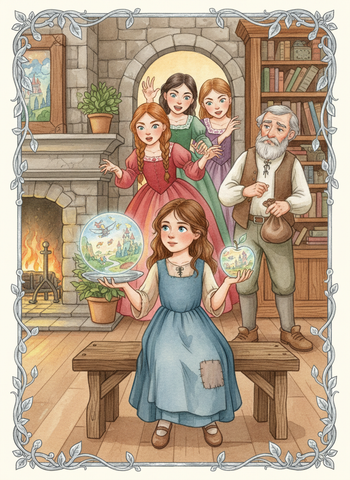
The youngest daughter, mocked by her family as "the Fool," asks her father for a strange gift from the fair — a silver saucer and a crystal apple that reveal magical visions, and stir dangerous envy among her sisters.
Once a peasant lived with his wife, and they had three daughters: two were finely dressed and clever, but the third was a simple girl; the sisters and the father and mother as well called her the Little Fool. They hustled the Little Fool, thrust her about this way and that and forced her to work. She never said a word and was always ready to weed the grass, break off lamp-splinters, feed the cows and ducks, and whatever anybody asked for the Little Fool would bring. They had only to say, “Fool, go and fetch this!” or “Fool, come and look here!”
Érase una vez un campesino que vivía con su esposa, y tenían tres hijas: dos eran elegantes y astutas, pero la tercera era una muchacha sencilla; las hermanas, y también el padre y la madre, la llamaban la Tontita. Empujaban a la Tontita de un lado a otro y la obligaban a trabajar. Ella nunca decía una palabra y siempre estaba dispuesta a arrancar la hierba, partir astillas para el candil, alimentar a las vacas y los patos, y lo que fuera que le pidieran a la Tontita, ella lo traía. Bastaba con decir: «¡Tonta, ve a buscar esto!» o «¡Tonta, ven a mirar aquí!».
One day the peasant went with his hay to the fair, and he asked his daughters, “What shall I bring you as your fairing?”
Un día el campesino fue con su heno a la feria, y les preguntó a sus hijas: «¿Qué queréis que os traiga de regalo?».
One daughter asked, “Buy me some red cloth for a sarafan.” The other asked, “Buy me some scarlet nankin.” But the Fool sat still and said nothing.
Una hija pidió: «Cómprame tela roja para un sarafán». La otra pidió: «Cómprame nanquín escarlata». Pero la Tontita se quedó callada y no dijo nada.
Well, after all, the Fool was his daughter, and her father felt sorry for her, so he asked her, “What would you like to have, Fool?”
Bueno, al fin y al cabo la Tontita era su hija, y su padre sintió lástima por ella, así que le preguntó: «¿Qué te gustaría tener, Tonta?».
So the Fool smiled and said, “Buy me, my own father, a silver saucer and a crystal apple.”
Entonces la Tontita sonrió y dijo: «Cómprame, padre mío, un plato de plata y una manzana de cristal».
“What do you mean?” asked the sisters.
«¿Qué quieres decir?», preguntaron las hermanas.
“I should then roll the apple on the saucer, and should speak words which an old woman taught me in return for my giving her a loaf of white bread.” So the peasant promised, and went away.
«Entonces haría rodar la manzana sobre el plato, y diría unas palabras que me enseñó una anciana a cambio de darle yo un pan blanco». Así que el campesino se lo prometió, y se marchó.
Whether he went far or near, whether he took long or short, anyhow he went to the fair, sold his hay, bought the fairings, gave his one daughter the scarlet nankin, the other the red cloth for a sarafan and the Fool a silver saucer and a crystal apple. He came back home and he showed them. Both sisters were overjoyed, sewed sarafans, and mocked the Fool, and waited to see what she would do with her silver saucer and crystal apple.
Ya fuera lejos o cerca, ya tardara mucho o poco, de todos modos llegó a la feria, vendió su heno, compró los regalos, dio a una hija el nanquín escarlata, a la otra la tela roja para un sarafán, y a la Tontita un plato de plata y una manzana de cristal. Volvió a casa y se los mostró. Ambas hermanas se llenaron de alegría, cosieron sus sarafanes, y se burlaron de la Tontita, y esperaron a ver qué haría ella con su plato de plata y su manzana de cristal.
But the Fool did not eat the apple, but sat in a corner and whispered, “Roll, roll, roll, little apple, on the silver saucer, and show me all the cities and the fields, all the woods and the seas, and the heights of the hills and the fairness of heaven.”
Pero la Tontita no se comió la manzana, sino que se sentó en un rincón y susurró: «Rueda, rueda, rueda, manzanita, sobre el plato de plata, y muéstrame todas las ciudades y los campos, todos los bosques y los mares, y la altura de las colinas y la hermosura del cielo».
Then the apple rolled about on the saucer; a transparency came over the silver; and, on the saucer, all the cities, one after the other, became visible, all the ships on the seas, and the regiments in the fields, and the heights of the mountains, and the beauties of the sky. Sunset appeared after sunset and the stars gathered in their nocturnal dances: it was all so beautiful and so lovely as no tale can tell and no pen can write.
Entonces la manzana rodó sobre el plato; una transparencia cubrió la plata; y, en el plato, todas las ciudades, una tras otra, se hicieron visibles, todos los barcos en los mares, y los regimientos en los campos, y la altura de las montañas, y las bellezas del cielo. Aparecía un atardecer tras otro y las estrellas se congregaban en sus danzas nocturnas: todo era tan hermoso y tan encantador como ningún cuento puede contar ni ninguna pluma puede escribir.
Then the sisters looked on and they became envious and wanted to take the saucer away from their sister, but she would not exchange her saucer for anything else in the world. So the evil sisters walked about, called out and began to talk. “Oh, my darling sisters, let us go into the wood and pick berries and look for wild strawberries!”
Entonces las hermanas miraban y se llenaban de envidia y querían quitarle el plato a su hermana, pero ella no lo cambiaría por nada en el mundo. Así que las hermanas malvadas se pusieron a caminar, llamaron y empezaron a hablar. «Ay, queridas hermanitas, vayamos al bosque a recoger bayas y a buscar fresas silvestres».
So the Fool gave her saucer to her father and herself went into the wood. She wandered about with her sisters, plucked the strawberries, and saw a spade lying on the grass; then the other sisters took the spade and began beating the Fool with it, slew the Fool, buried her under a silver birch, and came back to their father late at night, saying, “The Little Fool ran away from us, we could not find her, we went all over the wood searching for her. We suppose the wolves must have eaten her up.”
Así que la Tontita le dio su plato a su padre y ella misma se fue al bosque. Anduvo por allí con sus hermanas, recogió fresas, y vio una pala tirada sobre la hierba; entonces las otras hermanas tomaron la pala y comenzaron a golpear a la Tontita con ella, mataron a la Tontita, la enterraron bajo un abedul plateado, y volvieron con su padre ya entrada la noche, diciendo: «La Tontita se nos escapó, no pudimos encontrarla, recorrimos todo el bosque buscándola. Suponemos que los lobos deben de habérsela comido».
But the father was sorry. She was a Fool, but she was his daughter after all, and so the peasant wept for his daughter, took the silver saucer and the apple, put them into a coffer and locked them up. And the sisters also wept for her.
Pero el padre se apenó. Era una tonta, pero al fin y al cabo era su hija, y así el campesino lloró por su hija, tomó el plato de plata y la manzana, los puso en un cofre y los guardó bajo llave. Y las hermanas también lloraron por ella.
Soon a herd came by and the trumpet sounded at dawn. But the shepherd was taking his flock, and at dawn he sounded his trumpet and went into the wood to look for a little lamb. He saw a little hummock beside a silver birch, and on it all around ruby-red and azure flowers, and bulrushes standing above the flowers. So the young shepherd broke a bulrush, made a pipe of it, and a wonderful wonder happened, a marvellous marvel: the pipe began of itself to sing and to speak.
Pronto pasó un rebaño y sonó la trompeta al amanecer. Pues el pastor llevaba su rebaño, y al amanecer tocó su trompeta y se adentró en el bosque en busca de un corderito. Vio un pequeño montículo junto a un abedul plateado, y a su alrededor flores de un rojo rubí y un azul celeste, y espadañas que se alzaban por encima de las flores. Así que el joven pastor cortó una espadaña, se hizo con ella una flauta, y sucedió una maravilla asombrosa, un prodigio maravilloso: la flauta comenzó por sí sola a cantar y a hablar.
“Play on, play on, my little pipe. Console my father, console my guiding light, my father, and tell my mother of me, and my sisters, the little doves. For they killed me, the poor one, and for a silver saucer have severed me from light, all for my enchanted apple.”
«Toca, toca, mi pequeña flauta. Consuela a mi padre, consuela a mi luz guía, a mi padre, y cuéntale a mi madre de mí, y a mis hermanas, las palomitas. Pues me mataron, a la pobre de mí, y por un plato de plata me arrancaron de la luz, todo por mi manzana encantada».
People heard and ran together, the entire village thronged round the shepherd, asked him who had been slain. There was no end to the question. “Good folks all,” said the shepherd, “I do not know anything about it. I was looking for a little sheep in the wood, and I saw a knoll, on the knoll flowers, and a bulrush over the knoll. I broke off a bulrush, carved myself a pipe out of it, and the pipe began singing and speaking of itself.”
La gente oyó y acudió corriendo, todo el pueblo se agolpó alrededor del pastor, le preguntaron quién había sido asesinado. No había fin a las preguntas. «Buena gente», dijo el pastor, «no sé nada de esto. Estaba buscando una ovejita en el bosque, y vi un montículo, sobre el montículo flores, y una espadaña sobre el montículo. Corté una espadaña, me tallé una flauta con ella, y la flauta comenzó a cantar y a hablar por sí sola».
Now it so happened that the father of the Little Fool was there, heard the words of the shepherd, wanted to lay hold of the pipe, when the pipe began singing, “Play on, play on, little pipe: this is my father; console him with my mother. My poor little self they slew, they withdrew from the white world, all for the sake of my silver vessel and crystal apple.”
Y sucedió que el padre de la Tontita estaba allí, oyó las palabras del pastor, quiso apoderarse de la flauta, cuando la flauta comenzó a cantar: «Toca, toca, florecita flauta: este es mi padre; consuélalo junto con mi madre. A mi pobre yo la mataron, la apartaron del mundo blanco, todo por mi vasija de plata y mi manzana de cristal».
“Lead us, shepherd,” said the father, “where you broke off the bulrush.” So they followed the shepherd into the wood and to the knoll, and they were amazed at the beautiful flowers, ruby-red, sky-blue, that grew there.
«Guíanos, pastor», dijo el padre, «hasta donde cortaste la espadaña». Así que siguieron al pastor hasta el bosque y hasta el montículo, y se maravillaron ante las hermosas flores, rojo rubí, azul cielo, que allí crecían.
Then they began to dig up the knoll and discovered the dead body. The father clasped his hands, groaned as he recognised his unfortunate daughter, saw her lying there slain, not knowing by whom she had been buried. And all the good folks asked who had been the slayers, who had been the murderers. Then the pipe began playing and speaking of itself. “O my light, my father, my sisters called me to the wood: they killed me here to get my saucer, my silver saucer, and my crystal apple. You cannot raise me from my heavy sleep till you get water from the Tsar’s well.”
Entonces comenzaron a cavar el montículo y descubrieron el cuerpo sin vida. El padre juntó las manos, gimió al reconocer a su desdichada hija, la vio allí tendida, asesinada, sin saber quién la había enterrado. Y toda la buena gente preguntaba quiénes habían sido los asesinos, quiénes habían sido los homicidas. Entonces la flauta comenzó a tocar y a hablar por sí sola. «Oh, luz mía, padre mío, mis hermanas me llamaron al bosque: me mataron aquí para quedarse con mi plato, mi plato de plata, y mi manzana de cristal. No podréis levantarme de mi pesado sueño hasta que traigáis agua del pozo del Zar».
The two envious sisters trembled, paled, and their soul was in flames. They acknowledged their guilt. They were seized, bound, locked up in a dark vault at the Tsar’s pleasure. But the father set out on his way to the capital city. The road was long or short. At last he reached the town and came up to the palace. The Tsar, the little sun, was coming down the golden staircase. The old man bowed down to the earth and asked for the Tsar’s mercy. Then the Tsar, the hope, said, “Take the water of life from the Tsar’s well. When your daughter revives, bring her here with the saucer, the apple, and the evil-doing sisters.”
Las dos hermanas envidiosas temblaron, palidecieron, y su alma ardía en llamas. Reconocieron su culpa. Fueron apresadas, atadas, encerradas en una cripta oscura a merced del Zar. Pero el padre partió hacia la capital. El camino fue largo o corto. Al fin llegó a la ciudad y subió al palacio. El Zar, el solecito, bajaba por la escalera dorada. El anciano se postró hasta el suelo y pidió la clemencia del Zar. Entonces el Zar, la esperanza, dijo: «Toma el agua de la vida del pozo del Zar. Cuando tu hija reviva, tráela aquí con el plato, la manzana, y las hermanas malhechoras».
The old man was overjoyed, bowed down to earth and took the phial with the living water, ran into the wood to the flowery knoll, and took up the body. As soon as ever he sprinkled it with the water his daughter sprang up in front of him alive, and hung like a dove upon her father’s neck.
El anciano se llenó de alegría, se postró hasta el suelo y tomó el frasco con el agua viva, corrió al bosque hasta el montículo florido, y levantó el cuerpo. En cuanto lo roció con el agua, su hija se irguió frente a él, viva, y se colgó como una paloma del cuello de su padre.
All the people gathered together and wept. The old man went to the capital city. He was taken into the Tsar’s rooms. The Tsar, the little sun, appeared, saw the old man with his three daughters, two tied by the hands, and the third daughter like a spring flower, the light of Paradise in her eyes, with the dawn on her face, tears flowing in her eyes, falling like pearls.
Toda la gente se reunió y lloró. El anciano fue a la capital. Lo llevaron a las salas del Zar. El Zar, el solecito, apareció, vio al anciano con sus tres hijas, dos atadas de las manos, y la tercera hija como una flor de primavera, con la luz del Paraíso en los ojos, con el alba en el rostro, lágrimas fluyendo en sus ojos, cayendo como perlas.
The Tsar looked and was amazed, and was wroth with the wicked sisters. He asked the fair maiden, “Where are your saucer and the crystal apple?”
El Zar miró y se asombró, y se indignó con las hermanas malvadas. Preguntó a la hermosa doncella: «¿Dónde están tu plato y tu manzana de cristal?».
Then she took the little coffer out of her father’s hands, took out the apple and the saucer, and herself asked the Tsar, “What do you want to see, O Tsar my Emperor? Would you like to see your powerful cities, your valorous hosts, your ships on the sea, or the wonderful stars of the sky?” And she let the crystal apple roll about on the silver saucer, and on the saucer one after the other all the towns appeared in their shape; all the regiments with their banners and their arquebuses standing in warlike array, the leaders in front of the lines and the colonels in front of the platoons and the sergeants in front of their companies.
Entonces ella tomó el cofrecito de las manos de su padre, sacó la manzana y el plato, y ella misma le preguntó al Zar: «¿Qué deseáis ver, oh Zar, mi Emperador? ¿Os gustaría ver vuestras poderosas ciudades, vuestras huestes valerosas, vuestros barcos en el mar, o las maravillosas estrellas del cielo?». Y dejó que la manzana de cristal rodara sobre el plato de plata, y en el plato, una tras otra, aparecieron todas las ciudades con su forma; todos los regimientos con sus estandartes y sus arcabuces en formación de guerra, los líderes al frente de las filas y los coroneles al frente de los pelotones y los sargentos al frente de sus compañías.
And the guns fired and the shots flew, and the smoke wreathed and writhed: it was all visible to the eye. Then again the apple rolled about on the saucer, the crystal on the silver, and the sea could be seen billowing on the shore, and the ships swimming like swans, flags flying, issuing from the stern, and the noise of guns and cannon-smoke arriving like wreaths, all visible to the eye.
Y los cañones dispararon y los tiros volaron, y el humo se enroscó y se retorció: todo era visible a la vista. Entonces de nuevo la manzana rodó sobre el plato, el cristal sobre la plata, y se pudo ver el mar agitándose en la orilla, y los barcos nadando como cisnes, banderas ondeando, saliendo de la popa, y el ruido de los cañones y el humo de la pólvora llegando como guirnaldas, todo visible a la vista.
Then again the apple rolled on the saucer, the crystal on the silver, and the sky was red on the saucer, and little sun after little sun made its round, and the stars gathered on their dance. The Tsar was amazed at this wonder.
Entonces de nuevo la manzana rodó sobre el plato, el cristal sobre la plata, y el cielo se puso rojo en el plato, y un solecito tras otro hacía su ronda, y las estrellas se congregaban en su danza. El Zar se maravilló ante este prodigio.
But the fair maiden was lost in tears and fell down at the Tsar’s feet and begged for mercy, saying, “Tsar, your Majesty,” she said, “take my silver saucer and crystal apple if you will only forgive my sisters, and do not destroy them for my sake.”
Pero la hermosa doncella se deshizo en lágrimas y cayó a los pies del Zar y le rogó clemencia, diciendo: «Zar, majestad», dijo, «tomad mi plato de plata y mi manzana de cristal si solo perdonáis a mis hermanas, y no las destruís por mi culpa».
And the Tsar was melted by her tears and pardoned them at her request. She for sheer joy shouted out and fell upon her sisters. The Tsar looked round, was amazed, took the fair maiden by the hand, said to her in a kindly voice, “I must for your goodness love your beauty: will you be my wife and the Tsarítsa of my fair realm?”
Y el Zar se conmovió con sus lágrimas y las perdonó a petición suya. Ella, de puro gozo, gritó y se abalanzó sobre sus hermanas. El Zar miró a su alrededor, se asombró, tomó a la hermosa doncella de la mano, le dijo con voz amable: «Por vuestra bondad debo amar vuestra belleza: ¿queréis ser mi esposa y la Zarina de mi hermoso reino?».
“Tsar, your Majesty,” answered the fair maiden, “it is your imperial will, but it is the father’s will which is law amongst the daughters, and the blessing of their mother. If my father will, if my mother will bless me, I will.”
«Zar, majestad», respondió la hermosa doncella, «es vuestra voluntad imperial, pero es la voluntad del padre la que es ley entre las hijas, y la bendición de su madre. Si mi padre quiere, si mi madre quiere bendecirme, entonces sí».
Then the father bowed down to earth, and he sent for the mother, and the mother blessed her.
Entonces el padre se postró hasta el suelo, y mandó llamar a la madre, y la madre la bendijo.
“Yet I have one word more for you,” said the fair maiden to the Tsar: “Do not separate my kin from me, let my mother and my father and my sisters remain with me.”
«Aún tengo una palabra más para vos», dijo la hermosa doncella al Zar: «No apartéis de mí a los míos, dejad que mi madre y mi padre y mis hermanas permanezcan conmigo».
Then the sisters bowed down to her feet, and said, “We are not worthy!”
Entonces las hermanas se postraron a sus pies, y dijeron: «¡No somos dignas!».
“It has all been forgotten, my beloved sisters,” she said to them; “ye are my kin, ye are not strangers. He who bears in mind an ill bygone has lost his sight.” And as she said this, she smiled and raised her sisters up.
«Todo ha sido olvidado, hermanas mías amadas», les dijo ella; «sois mi sangre, no sois extrañas. Quien guarda memoria de un mal pasado ha perdido la vista». Y al decir esto, sonrió y levantó a sus hermanas.
And her sisters wept from sheer emotion, as the rivers flow, and would not rise from the ground.
Y sus hermanas lloraron de pura emoción, como corren los ríos, y no querían levantarse del suelo.
Then the Tsar bade them rise and looked on them kindly, bidding them remain in the city.
Entonces el Zar les ordenó levantarse y las miró con bondad, pidiéndoles que se quedaran en la ciudad.
There was a feast in the palace: the front steps glittered and glowed as though with flame, like the sun enwreathed in his beams. The Tsar and the Tsarítsa sat on a chariot, and the earth trembled, and the people ran up crying out, “Long live the Tsar and Tsarítsa!”
Hubo un banquete en el palacio: los escalones de la entrada relucían y resplandecían como si fueran de llama, como el sol envuelto en sus rayos. El Zar y la Zarina se sentaron en un carruaje, y la tierra tembló, y la gente corrió gritando: «¡Larga vida al Zar y a la Zarina!».
