The Tale of Mrs. Tiggy-Winkle
A free B1-level English story for language learners, readable online in 7 languages, with an option to listen via the free Storyteller app.
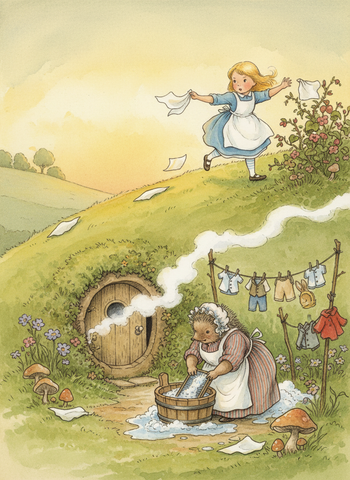
Chasing her lost handkerchiefs up a hillside, Lucie finds a tiny door into the hill — and the strangest, prickliest washerwoman imaginable, doing laundry for all the animals of the valley.
Once upon a time there was a little girl called Lucie, who lived at a farm called Little-town. She was a good little girl—only she was always losing her pocket-handkerchiefs!
Érase una vez una niñita llamada Lucía, que vivía en una granja llamada Villapequeña. Era una buena niña, solo que siempre perdía sus pañuelitos de bolsillo.
One day little Lucie came into the farm-yard crying—oh, she did cry so! "I've lost my pocket-handkin! Three handkins and a pinny! Have _you_ seen them, Tabby Kitten?"
Un día la pequeña Lucía llegó al patio de la granja llorando… ¡vaya que lloraba! «¡He perdido mi pañuelito! ¡Tres pañuelitos y un delantal! ¿Los has visto tú, Gatita Atigrada?»
The Kitten went on washing her white paws; so Lucie asked a speckled hen—
La Gatita siguió lavándose sus patitas blancas; así que Lucía le preguntó a una gallina moteada—
"Sally Henny-penny, have _you_ found three pocket-handkins?"
«Sally Gallina-pinta, ¿has encontrado tú tres pañuelitos de bolsillo?»
But the speckled hen ran into a barn, clucking—
Pero la gallina moteada corrió hacia un granero, cacareando—
"I go barefoot, barefoot, barefoot!"
«¡Yo ando descalza, descalza, descalza!»
And then Lucie asked Cock Robin sitting on a twig.
Y entonces Lucía le preguntó al Petirrojo, que estaba posado en una ramita.
Cock Robin looked sideways at Lucie with his bright black eye, and he flew over a stile and away.
El Petirrojo miró de reojo a Lucía con su brillante ojo negro, y voló por encima de una escalerilla y se alejó.
Lucie climbed upon the stile and looked up at the hill behind Little-town—a hill that goes up—up—into the clouds as though it had no top!
Lucía trepó por la escalerilla y miró hacia la colina detrás de Villapequeña… una colina que sube y sube hasta las nubes, ¡como si no tuviera cima!
And a great way up the hill-side she thought she saw some white things spread upon the grass.
Y muy arriba, en la ladera de la colina, le pareció ver unas cosas blancas extendidas sobre la hierba.
Lucie scrambled up the hill as fast as her stout legs would carry her; she ran along a steep path-way—up and up—until Little-town was right away down below—she could have dropped a pebble down the chimney!
Lucía trepó la colina tan rápido como sus robustas piernas se lo permitieron; corrió por un sendero empinado, subiendo y subiendo, hasta que Villapequeña quedó allá abajo, muy abajo… ¡podría haber dejado caer una piedrecita por la chimenea!
Presently she came to a spring, bubbling out from the hill-side.
Al poco rato llegó a un manantial que brotaba burbujeante de la ladera de la colina.
Some one had stood a tin can upon a stone to catch the water—but the water was already running over, for the can was no bigger than an egg-cup! And where the sand upon the path was wet—there were foot-marks of a _very_ small person.
Alguien había colocado una lata sobre una piedra para recoger el agua… pero el agua ya se derramaba, ¡pues la lata no era más grande que una huevera! Y donde la arena del camino estaba mojada… había huellas de una persona muy, muy pequeña.
Lucie ran on, and on.
Lucía siguió corriendo, y corriendo.
The path ended under a big rock. The grass was short and green, and there were clothes—props cut from bracken stems, with lines of plaited rushes, and a heap of tiny clothes pins—but no pocket-handkerchiefs!
El sendero terminaba bajo una gran roca. La hierba era corta y verde, y había unos tendederos hechos de tallos de helecho, con cuerdas de junco trenzado, y un montoncito de diminutas pinzas de ropa… ¡pero ni un solo pañuelo de bolsillo!
But there was something else—a door! straight into the hill; and inside it some one was singing—
Pero había algo más: ¡una puerta! que se hundía directo en la colina; y por dentro alguien estaba cantando—
"Lily-white and clean, oh! With little frills between, oh! Smooth and hot—red rusty spot Never here be seen, oh!"
«¡Blanco de azucena, limpio, oh! Con volantitos entre medio, oh! Suave y caliente… mancha roja oxidada Jamás aquí se verá, oh!»
Lucie, knocked—once—twice, and interrupted the song. A little frightened voice called out "Who's that?"
Lucía llamó a la puerta, una vez, dos veces, y interrumpió la canción. Una vocecita asustada exclamó: «¿Quién anda ahí?»
Lucie opened the door: and what do you think there was inside the hill?—a nice clean kitchen with a flagged floor and wooden beams—just like any other farm kitchen. Only the ceiling was so low that Lucie's head nearly touched it; and the pots and pans were small, and so was everything there.
Lucía abrió la puerta: ¿y qué creen que había dentro de la colina?… una linda cocina limpia con piso de losas y vigas de madera, igual que cualquier otra cocina de granja. Solo que el techo era tan bajo que la cabeza de Lucía casi lo rozaba; y las ollas y sartenes eran pequeñas, y así era todo allí dentro.
There was a nice hot singey smell; and at the table, with an iron in her hand stood a very stout short person staring anxiously at Lucie.
Había un olor agradable y caliente a chamuscado; y ante la mesa, con una plancha en la mano, estaba una persona muy rechoncha y bajita mirando a Lucía con ansiedad.
Her print gown was tucked up, and she was wearing a large apron over her striped petticoat. Her little black nose went sniffle, sniffle, snuffle, and her eyes went twinkle, twinkle; and underneath her cap—where Lucie had yellow curls—that little person had PRICKLES!
Su vestido de percal estaba remangado, y llevaba un gran delantal sobre su enagua a rayas. Su naricita negra hacía olisqueo, olisqueo, resoplido, y sus ojos brillaban, chispeaban; y debajo de su cofia, donde Lucía tenía rizos rubios, ¡esa personita tenía PÚAS!
"Who are you?" said Lucie. "Have you seen my pocket-handkins?"
«¿Quién eres?», dijo Lucía. «¿Has visto mis pañuelitos de bolsillo?»
The little person made a bob-curtsey—"Oh, yes, if you please'm; my name is Mrs. Tiggy-winkle; oh, yes if you please'm, I'm an excellent clear-starcher!" And she took something out of a clothes-basket, and spread it on the ironing-blanket.
La personita hizo una reverencia—«Oh, sí, si me permite, señorita; mi nombre es la señora Tiggy-winkle; oh, sí, si me permite, señorita, ¡soy una excelente almidonadora!» Y sacó algo de una cesta de ropa, y lo extendió sobre la manta de planchar.
"What's that thing?" said Lucie—"that's not my pocket-handkin?"
«¿Qué es esa cosa?», dijo Lucía… «no es mi pañuelito, ¿verdad?»
"Oh no, if you please'm; that's a little scarlet waist-coat belonging to Cock Robin!"
«Oh no, si me permite, señorita; ese es un pequeño chaleco escarlata que pertenece al Petirrojo.»
And she ironed it and folded it, and put it on one side.
Y lo planchó y lo dobló, y lo puso a un lado.
Then she took something else off a clothes-horse—
Luego tomó otra cosa de un tendedero—
"That isn't my pinny?" said Lucie.
«¿Ese no es mi delantal?», dijo Lucía.
"Oh no, if you please'm; that's a damask table-cloth belonging to Jenny Wren; look how it's stained with currant wine! It's very bad to wash!" said Mrs. Tiggy-winkle.
«Oh no, si me permite, señorita; ese es un mantel de damasco que pertenece a Jenny Reyezuelo; ¡mire cómo está manchado de vino de grosella! ¡Es muy difícil de lavar!» dijo la señora Tiggy-winkle.
Mrs. Tiggy-winkle's nose went sniffle, sniffle, snuffle, and her eyes went twinkle, twinkle; and she fetched another hot iron from the fire.
La nariz de la señora Tiggy-winkle hacía olisqueo, olisqueo, resoplido, y sus ojos brillaban, chispeaban; y fue a buscar otra plancha caliente del fuego.
"There's one of my pocket-handkins!" cried Lucie—"and there's my pinny!"
«¡Ahí está uno de mis pañuelitos!», exclamó Lucía… «¡y ahí está mi delantal!»
Mrs. Tiggy-winkle ironed it, and goffered it, and shook out the frills.
La señora Tiggy-winkle lo planchó, le hizo los volantes, y sacudió los frunces.
"Oh that _is_ lovely!" said Lucie.
«¡Oh, eso es precioso!», dijo Lucía.
"And what are those long yellow things with fingers like gloves?"
«¿Y qué son esas cosas largas y amarillas con dedos como guantes?»
"Oh, that's a pair of stockings belonging to Sally Henny-penny—look how she's worn the heels out with scratching in the yard! She'll very soon go barefoot!" said Mrs. Tiggy-winkle.
«Oh, ese es un par de medias que pertenecen a Sally Gallina-pinta… ¡mire cómo ha gastado los talones de tanto rascar en el corral! ¡Pronto andará descalza!», dijo la señora Tiggy-winkle.
"Why, there's another handkersniff—but it isn't mine; it's red?"
«Vaya, hay otro pañuelito… pero no es mío; ¿es rojo?»
"Oh no, if you please'm; that one belongs to old Mrs. Rabbit; and it _did_ so smell of onions! I've had to wash it separately, I can't get out the smell."
«Oh no, si me permite, señorita; ese pertenece a la vieja señora Coneja; ¡y de veras olía a cebolla! He tenido que lavarlo aparte, no logro quitarle el olor.»
"There's another one of mine," said Lucie.
«Ese sí es otro mío», dijo Lucía.
"What are those funny little white things?"
«¿Qué son esas cositas blancas tan graciosas?»
"That's a pair of mittens belonging to Tabby Kitten; I only have to iron them; she washes them herself."
«Eso es un par de mitones que pertenecen a la Gatita Atigrada; solo tengo que plancharlos; ella misma se los lava.»
"There's my last pocket-handkin!" said Lucie.
«¡Ese es mi último pañuelito de bolsillo!», dijo Lucía.
"And what are you dipping into the basin of starch?"
«¿Y qué es lo que estás remojando en el bol de almidón?»
"They're little dicky shirt-fronts belonging to Tom Titmouse—most terrible particular!" said Mrs. Tiggy-winkle. "Now I've finished my ironing; I'm going to air some clothes."
«Son pequeñas pecheras de camisa que pertenecen a Tomás Herrerillo… ¡de lo más exigente!», dijo la señora Tiggy-winkle. «Ya he terminado de planchar; ahora voy a airear un poco de ropa.»
"What are these dear soft fluffy things?" said Lucie.
«¿Qué son estas cositas suaves y esponjosas?», dijo Lucía.
"Oh those are woolly coats belonging to the little lambs at Skelghyl."
«Ah, esos son abriguitos de lana que pertenecen a los corderitos de Skelghyl.»
"Will their jackets take off?" asked Lucie.
«¿Se les quitan las chaquetitas?», preguntó Lucía.
"Oh yes, if you please'm; look at the sheep-mark on the shoulder. And here's one marked for Gatesgarth, and three that come from Little-town. They're _always_ marked at washing!" said Mrs. Tiggy-winkle.
«Oh sí, si me permite, señorita; mire la marca de oveja en el hombro. Y aquí hay una marcada para Gatesgarth, y tres que vienen de Villapequeña. ¡Siempre se marcan al lavarlas!», dijo la señora Tiggy-winkle.
And she hung up all sorts and sizes of clothes—small brown coats of mice; and one velvety black moleskin waist-coat; and a red tailcoat with no tail belonging to Squirrel Nutkin; and a very much shrunk blue jacket belonging to Peter Rabbit; and a petticoat, not marked, that had gone lost in the washing—and at last the basket was empty!
Y colgó toda clase de ropa de todos los tamaños: pequeños abrigos marrones de ratones; y un chaleco de terciopelo negro de piel de topo; y una levita roja sin cola que pertenecía a la Ardilla Nutkin; y una chaquetita azul muy encogida que pertenecía a Pedro Conejo; y una enagua sin marcar, que se había extraviado en el lavado… ¡y por fin la cesta quedó vacía!
"Then Mrs. Tiggy-winkle made tea—a cup for herself and a cup for Lucie. They sat before the fire on a bench and looked sideways at one another. Mrs. Tiggy-winkle's hand, holding the tea-cup, was very very brown, and very very wrinkly with the soap-suds; and all through her gown and her cap, there were _hair-pins_ sticking wrong end out; so that Lucie didn't like to sit too near her.
Entonces la señora Tiggy-winkle preparó té… una taza para ella y una taza para Lucía. Se sentaron ante el fuego en un banco y se miraron de reojo la una a la otra. La mano de la señora Tiggy-winkle, sosteniendo la taza de té, era muy, muy morena, y muy, muy arrugada por el jabón; y por todo su vestido y su cofia había horquillas clavadas con la punta hacia afuera; así que a Lucía no le gustaba sentarse demasiado cerca de ella.
When they had finished tea, they tied up the clothes in bundles; and Lucie's pocket-handkerchiefs were folded up inside her clean pinny, and fastened with a silver safety-pin.
Cuando terminaron el té, ataron la ropa en fardos; y los pañuelitos de bolsillo de Lucía quedaron doblados dentro de su delantal limpio, y sujetos con un imperdible de plata.
And then they made up the fire with turf, and came out and locked the door, and hid the key under the door-sill.
Y luego avivaron el fuego con turba, y salieron y cerraron con llave la puerta, y escondieron la llave bajo el umbral.
Then away down the hill trotted Lucie and Mrs. Tiggy-winkle with the bundles of clothes!
Entonces, colina abajo, bajaron trotando Lucía y la señora Tiggy-winkle con los fardos de ropa.
All the way down the path little animals came out of the fern to meet them; the very first that they met were Peter Rabbit and Benjamin Bunny!
Todo el camino abajo, pequeños animales salían de entre los helechos a su encuentro; los primeros que se encontraron fueron Pedro Conejo y Benjamín Conejito.
And she gave them their nice clean clothes; and all the little animals and birds were so very much obliged to dear Mrs. Tiggy-winkle.
Y ella les entregó su linda ropa limpia; y todos los animalitos y pajarillos quedaron tan agradecidos con la querida señora Tiggy-winkle.
So that at the bottom of the hill when they came to the stile, there was nothing left to carry except Lucie's one little bundle.
Así que, al pie de la colina, cuando llegaron a la escalerilla, ya no quedaba nada que llevar salvo el único fardito de Lucía.
Lucie scrambled up the stile with the bundle in her hand; and then she turned to say "Good-night," and to thank the washer-woman—But what a _very_ odd thing! Mrs. Tiggy-winkle had not waited either for thanks or for the washing bill!
Lucía trepó la escalerilla con el fardo en la mano; y entonces se volvió para decir «Buenas noches», y para agradecer a la lavandera… Pero ¡qué cosa tan extraña! ¡La señora Tiggy-winkle no había esperado ni el agradecimiento ni la cuenta del lavado!
She was running running running up the hill—and where was her white frilled cap? and her shawl? and her gown—and her petticoat?
Iba corriendo, corriendo, corriendo colina arriba… ¿y dónde estaba su cofia blanca con volantes? ¿y su chal? ¿y su vestido… y su enagua?
And _how_ small she had grown—and _how_ brown—and covered with PRICKLES!
¡Y qué pequeña se había vuelto… y qué morena… y cubierta de PÚAS!
Why! Mrs. Tiggy-winkle was nothing but a HEDGEHOG.
¡Vaya! La señora Tiggy-winkle no era más que un ERIZO.
(Now some people say that little Lucie had been asleep upon the stile—but then how could she have found three clean pocket-handkins and a pinny, pinned with a silver safety-pin?
(Ahora bien, algunos dicen que la pequeña Lucía se había quedado dormida sobre la escalerilla… pero entonces, ¿cómo pudo haber encontrado tres pañuelitos de bolsillo limpios y un delantal, sujeto con un imperdible de plata?
And besides—_I_ have seen that door into the back of the hill called Cat Bells—and besides _I_ am very well acquainted with dear Mrs. Tiggy-winkle!)
Y además… yo he visto esa puerta hacia el interior de la colina llamada Cat Bells… y además, yo conozco muy bien a la querida señora Tiggy-winkle.)
