The Ghostwriter's Chapter
Una historia gratuita en inglés de nivel B2 para estudiantes, para leer en línea en 4 idiomas, con opción de escucharla en la app gratuita Storyteller.
A ghostwriter argues with a retired football coach who wants to cut the most honest chapter from his memoir.
¡Ese fue el avance! Escucha la historia completa en la app gratuita Storyteller. Descargar la app
El audio no está disponible en este momento.
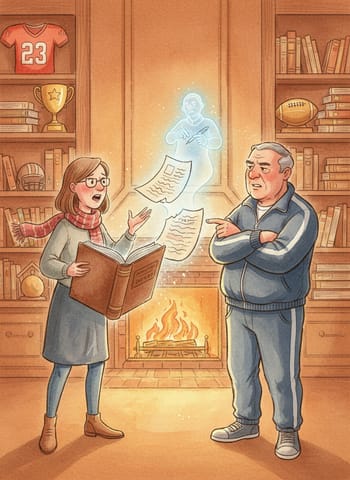
Dafne has been working with Jens for five months, and she knows his habits by now. He drinks his tea cold. He answers her questions with a short nod, as if every one of them were a referee's decision. And he writes in the margins in thick red pen, always in capitals. Today, beside the title of chapter nine, he has written a single word: CUT.
Dafne lleva cinco meses trabajando con Jens, y a estas alturas conoce sus costumbres. Se toma el té frío. Responde a sus preguntas con un breve asentimiento, como si cada una fuera una decisión arbitral. Y escribe en los márgenes con un grueso bolígrafo rojo, siempre en mayúsculas. Hoy, junto al título del capítulo nueve, ha escrito una sola palabra: CORTAR.
Chapter nine is called "The Winter Without a Win." It covers the season, forty years ago, when his youth team lost twelve matches in a row. Dafne has spent two weeks on it, working from a biscuit tin of old scoresheets that has never been shown to anyone. Each sheet is marked in his handwriting with the date, the score and the weather.
El capítulo nueve se llama «El invierno sin victorias». Abarca la temporada, hace cuarenta años, en que su equipo juvenil perdió doce partidos seguidos. Dafne ha dedicado dos semanas a él, trabajando a partir de una lata de galletas con viejas planillas de resultados que nunca se han mostrado a nadie. Cada planilla está marcada con su letra con la fecha, el marcador y el clima.
"Nobody wants to read about losing," Jens says, stirring his tea. "People buy a coach's book to read about the cups."
«Nadie quiere leer sobre perder», dice Jens, revolviendo su té. «La gente compra el libro de un entrenador para leer sobre las copas.»
"People buy a coach's book to find out who he is," Dafne says. "May I tell you what I think?"
«La gente compra el libro de un entrenador para saber quién es», dice Dafne. «¿Puedo decirte lo que pienso?»
He shrugs, which she has learned means yes.
Él se encoge de hombros, lo que ella ha aprendido que significa sí.
"The cup chapters are good, but they could have been written about anyone. If a stranger had won those games, the sentences would be the same. This is the only chapter where you sound like a man who is afraid." She turns the page toward him. "You wrote that you stood in the cold after the twelfth defeat and told the boys you were proud of them. And that you didn't know whether it was true."
«Los capítulos de las copas son buenos, pero podrían haberse escrito sobre cualquiera. Si un desconocido hubiera ganado esos partidos, las frases serían las mismas. Este es el único capítulo donde suenas como un hombre con miedo.» Gira la página hacia él. «Escribiste que te quedaste de pie en el frío después de la duodécima derrota y les dijiste a los chicos que estabas orgulloso de ellos. Y que no sabías si era verdad.»
Jens looks out of the window. Outside, a neighbor's children are kicking a ball against a garage door, over and over, the sound as steady as a clock.
Jens mira por la ventana. Afuera, los niños de un vecino patean una pelota contra la puerta de un garaje, una y otra vez, con un sonido tan constante como un reloj.
"That's private," he says. "If I print it, the boys will read it. Some of them are grandfathers now."
«Eso es privado», dice. «Si lo imprimo, los chicos lo leerán. Algunos ya son abuelos.»
"They will read what you wrote," Dafne says. "They will also find out that somebody remembered what that winter was like for them. You remember the weather, Jens. Every match. Rain, sleet, wind from the east. You couldn't have kept such records if you hadn't cared."
«Leerán lo que escribiste», dice Dafne. «Y también descubrirán que alguien recordó cómo fue ese invierno para ellos. Tú recuerdas el clima, Jens. Cada partido. Lluvia, aguanieve, viento del este. No habrías podido llevar esos registros si no te hubiera importado.»
He is silent for a long time. Dafne had been expecting an argument, perhaps even a raised voice. She has prepared herself to lose this one, although she would hate to.
Él guarda silencio durante mucho tiempo. Dafne esperaba una discusión, quizá incluso una voz alzada. Se ha preparado para perder esta, aunque lo detestaría.
"My wife used to say the same thing," he says at last. "She said I only kept the records of the games that hurt." He pulls the page toward him, uncaps the red pen and holds it above the paper.
«Mi esposa solía decir lo mismo», dice por fin. «Decía que yo solo guardaba el registro de los partidos que dolían.» Acerca la página hacia sí, destapa el bolígrafo rojo y lo sostiene sobre el papel.
Dafne tries not to watch his hand. She looks at the window, at the children and their ball, at anything else.
Dafne intenta no mirar su mano. Mira la ventana, a los niños y su pelota, cualquier otra cosa.
When she looks back, the word CUT has a line through it, thick and straight. Beneath it, in the same red capitals, Jens has written another word: KEEP.
Cuando vuelve a mirar, la palabra CORTAR tiene una línea encima, gruesa y recta. Debajo, con las mismas mayúsculas rojas, Jens ha escrito otra palabra: CONSERVAR.
He slides the page across the table. "Fix the ending," he says. "It's far too kind to me."
Desliza la página por la mesa. «Arregla el final», dice. «Es demasiado amable conmigo.»