The Referee's Last Season
A free C1-level English story for language learners, readable online in 4 languages, with an option to listen via the free Storyteller app.
On the final day of her last season, a veteran amateur referee is asked a quiet question by a teenage captain that she has avoided for thirty-one years.
That was the preview! Hear the full story in the free Storyteller app. Get the app
Audio isn't available right now.
Mathilde had refereed for thirty-one seasons, and she had decided, without telling anyone, that the thirty-second would be her last. She began to notice things the way people notice the furniture in a house they are about to sell. The line-marking machine had a cracked wheel. The bench had a missing slat. Wet grass and liniment clung to her kit bag until Wednesday.
Every match was the same and different. There was always a father shouting about offside from behind the rope, and always a goalkeeper who blamed the low sun. Somewhere around the seventieth minute there was always a moment when the whole field seemed to lean toward her and wait. Having answered some nine hundred of those moments, she had trained herself to answer in a single motion: whistle, arm, one short word. Nobody had ever asked whether she was sure. Sureness was what they wanted from her, though the league paid her only enough to cover petrol and the occasional new pair of boots.
Her last match was an under-eighteens game on a grey Sunday in March, between two sides with nothing left to play for. With ten minutes remaining, a cross swung into the area and a defender's arm went up. Whether the ball had struck it or the arm had moved toward the ball, Mathilde could not have sworn; she had been twenty metres back, half hidden behind a forward. She pointed to the spot anyway.
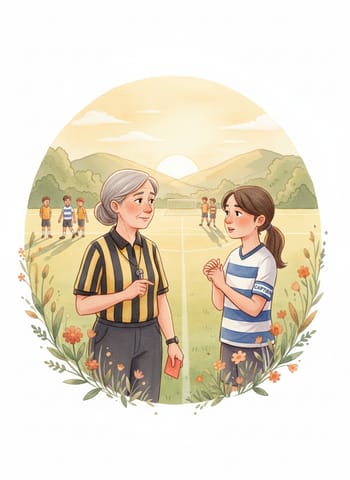
The boy who came toward her was the home captain, a long-limbed centre-back called Zeno. He did not shout. Rarely had a player so young looked so unafraid of her. He stopped an arm's length away, put his hands behind his back, and said, "I'm not going to argue. I only want to know if you're sure."
"The arm was away from your body," she said. It was the sentence she had used a hundred times.
"You say it the same way when you're right and when you're wrong," Zeno said, without heat. "I've watched you since I was nine. It's like there's nobody in the whistle."
Mathilde looked at him a moment too long. What struck her was not the accusation but how exactly it fitted. Her sister had said something similar at a wedding years before, that Mathilde spoke to people as if she were issuing them a ruling, and Mathilde had laughed and refilled her glass. Had the boy raised his voice, she would have shown him a card without breaking stride. Speaking quietly, he had left her nowhere to stand.
If she had allowed herself one honest doubt aloud in her first decade, she thought, she might not need a seventeen-year-old to do it for her. The certainty had been a uniform, like the black kit, and at some point she had stopped taking it off.
"I think it hit your arm," she said slowly. "From where I was, I couldn't see the ball move. I'm not certain. I gave it because the arm was out, and that is what the law asks me to judge."
Zeno considered this, then nodded once, like a customer checking his change. "Thank you," he said, and jogged back to his line.
The striker hit the penalty against the post. Nobody on either side said a word about it, and Mathilde found, for the first time in thirty-one years, that she was watching the players and not the clock. At the end she shook eleven hands on each side. Two boys said, "Thanks, ref." One said, "Thanks, Mathilde," which she had not expected and did not correct.
Afterwards she did not return the keys to the shed. She walked a full lap of the pitch, something she had never once done. She passed the bench with the missing slat and the machine with the cracked wheel, and at six the floodlights clicked off on their timer. Then she kept walking in the dark until her hand found the gate.