The Grandfather's Glacier
A free C1-level English story for language learners, readable online in 4 languages, with an option to listen via the free Storyteller app.
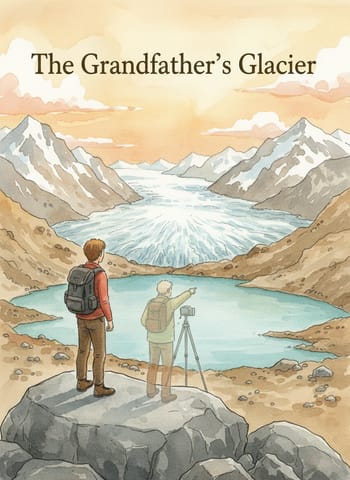
Fifty years after his grandfather photographed a glacier, Malcolm hikes to the same rock to see how far the ice has gone.
That was the preview! Hear the full story in the free Storyteller app. Get the app
Audio isn't available right now.
The print had lived for fifty years in a biscuit tin, and Malcolm carried it up the valley in a freezer bag inside a hardback book, which he had judged the safest place for it. It showed a wall of ice filling the head of the valley, grey-white and ribbed. A small figure in a dark jacket stood on a rock in the foreground, one arm raised against the glare. On the back, in his grandfather's pencil, were a date and four words: "Still bigger than I expected."
The path followed a river that was the colour of weak tea and then, after the second hour, the colour of milk. Malcolm had read the trail notes the night before. The end of the glacier was now about five kilometres further up than the old maps suggested, a sentence he had read twice without taking in. He climbed steadily, stopping at each new bend to compare the print with the view, and the ridgelines matched, every one, with a precision that made the missing part easier to see.
By midday the valley held nothing but gravel, meltwater and the occasional boulder the size of a van. The ice, when he finally saw it, was a long way off and a long way up, a pale tongue wedged into a notch between two peaks. Nowhere between him and it was there any trace of the wall that the print showed. Beside the path ran a line of scraped rock, thirty metres above his head, which he understood after a moment to mark the height of the glacier on the day his grandfather stood here.
The rock was easy to find. What made it unmistakable was the lichen: a thumb-shaped smear of orange on its north face, exactly as it appeared in the print, only a little wider now. He climbed on to it with some care, because it was wet, and stood where the small figure had stood. Having imagined this moment for months, he noticed that he felt less than he had planned to, and was paying very close attention to his boots instead.
He held the print at arm's length against the valley and let the two scenes settle over one another. The ridges lined up. The dark band of rock halfway up the left-hand peak lined up. The wall of ice that had once filled the lower half of the frame was simply not there. What stood in its place was a quantity of air and distance that the paper could not account for. It was the sound, not the sight, that took him by surprise: a steady ticking of meltwater falling somewhere out of view, in a place that used to be solid.
Malcolm took the photograph with his phone, then another, in case. Had his grandfather known, he thought, he would probably have said something dry about the weather; the man had never in his life commented directly on anything he cared about. A small wind came down the valley and lifted the corner of the print, and he put his thumb on it until it settled.
Before climbing down he turned the print over, took the pencil from his breast pocket, and wrote the date beneath the old one, in his own handwriting, which was worse. Under it he added four words of his own, then stopped, erased two of them, and left the rest. He slid the print back into its bag and the bag into the book, and started down the valley the long way, beside a river that was, for the moment, still the colour of milk.