The Dented Cup at Booth Four
A free B2-level English story for language learners, readable online in 7 languages, with an option to listen via the free Storyteller app.
A bridge toll collector dents the booth's old trophy the night before an inspection, and a maintenance man tries two very different ways to repair it.
That was the preview! Hear the full story in the free Storyteller app. Get the app
Audio isn't available right now.
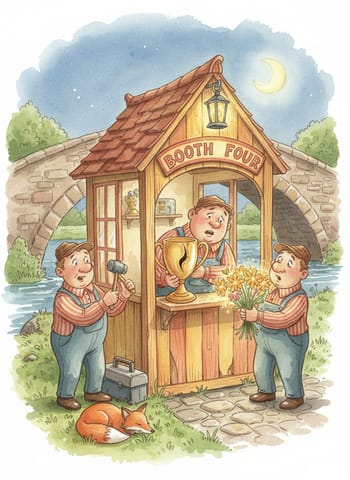
Sade had worked the late shift at Booth Four for fourteen years, and in all that time the trophy had never left its shelf. It was a squat silver cup, given to the bridge crew for ten years without a single counting error. Nobody talked about who had earned it. Everybody remembered who was responsible for it, and that person was Sade.
On the last night of the month she took it down to polish it before the inspector's visit. The cloth slipped. The cup rolled off the counter, struck the corner of the coin tray, and landed on the floor with a sound like a cracked bell.
She picked it up slowly. Near the base, the metal had folded inward in a shallow dent about the size of a thumb. Under the booth's yellow lamp, it looked enormous.
"It's only a cup," she said aloud, and she did not believe it.
The bridge was quiet at that hour. A car arrived every few minutes, its headlights sliding across the glass, and each driver held out a hand full of coins. Sade took the coins and gave back the change. Between cars, she turned the trophy over and over, searching for an angle from which the dent disappeared.
There was none.
Gil came at midnight to replace the lamp inside the ticket machine. He was the maintenance man, a broad, unhurried person who treated every problem as though it had all the time in the world. He glanced at the cup in her hands and then at her face.
"You've been holding that for an hour," he said.
"I dropped it," Sade said. "The inspector comes at eight."
"And the inspector has never dropped anything in his life, I suppose."
"That is not the point, Gil."
He held out his hand, and she gave him the cup with a reluctance that surprised her. He tilted it under the light and frowned the way he did at a stubborn bolt.
"Thin metal," he said. "It should come out easily."
His first attempt was simple. He found a wooden spoon in the lunch drawer. He slid the handle inside the cup and pushed outward against the dent. Nothing moved. He pushed harder. The silver gave a small, unhappy creak, and a hairline crack ran from the dent toward the rim.
Both of them stared at it.
"That was my fault," Gil said.
"It was mine," said Sade. "I should have put it in a drawer years ago."
"Years ago it would not have mattered." He set the cup on the counter with great care, as if it might break from being looked at. "Pushing from one point makes the metal stretch. We need something that pushes evenly, from every side at once."
"Like what?"
Gil did not answer. He walked to the small freezer in the corner, which the crew used for bottles of water, and opened the door. A moment later he was filling the cup from the tap, spilling a little across the counter, concentrating hard.
"Water gets bigger when it freezes," he said. "If the ice has nowhere else to go, it pushes on every wall of the cup. That might lift the dent without damaging anything more."
"Might," said Sade.
"Might," he agreed. "The crack is already there, so it cannot get much worse."
"It could get a lot worse. It could split in half."
"Then we will have a very honest trophy, in two pieces." He smiled. "Do you have a better idea?"
She did not. That was the uncomfortable truth of the night: she had spent an hour looking at the dent and not one minute thinking about it. Her mind had been busy with the inspector's face and with what he would write in his report. Fourteen careful years could be summed up by a single careless minute.
So she carried the cup to the freezer herself. Gil closed the door, and for a moment they both stood with their hands flat against it, like two people sealing a promise.
The hours were long. Cars passed, and she counted coins. A truck carrying cabbages needed change for a large banknote. A taxi driver sang the whole time he waited. A young couple asked whether the bridge had always been there. Sade had wondered the same thing on many nights, and she told them it was older than the city's name for the river.
Meanwhile Gil finished the lamp, then sat on an upturned crate beside her stool and talked. He said the trophy had never really belonged to the crew. A man who had since moved to the north gate had won it by luck, during a year when the machines happened to work. Nobody had checked the figures on the day it was awarded. They had simply believed the register.
Sade laughed for the first time that night.
"Then it is a trophy for being believed," she said.
"It is a trophy for turning up," said Gil. "You have turned up for fourteen years."
"That is not the same as being careful."
"No. But it is not nothing, either."
She thought about that for a long while. She had always imagined that the cup was a kind of promise, and that a dent was a broken one. Now it seemed more likely that the cup had only ever been a cup. The promise was the thing she did every night, with or without a shelf to put it on.
At two o'clock, a sharp noise came from the freezer, like a knuckle rapping on glass. Sade looked at Gil. Gil looked at the freezer. Neither of them moved, as if the sound might be frightened away.
"That was either good or very bad," he whispered.
"Do not open it," said Sade. "Not yet. Let it finish."
They waited until the sky behind the bridge towers began to turn the colour of dishwater. At last she opened the door herself and lifted out the cup, which was cold enough to sting her fingers. A white plug of ice stood in the middle. She tipped it into the sink and held the silver under the lamp.
The dent was gone.
A thin crack remained, running from the base toward the rim. It was so fine that she had to tilt the cup to find it. A little polish would hide it from anyone who was not looking. She would know it was there. She decided that this was perfectly acceptable.
"If you had told me yesterday that a bucket of ice could do this," she said, "I would have laughed at you."
"Water," said Gil. "A cupful of water."
"A cupful of water, then."
She put the trophy back on its shelf, turned a little so the crack faced the wall, and stepped back to look. It was an ordinary cup on an ordinary shelf. The light from the lamp slid over it the way it always had. Outside, the first car of the morning rolled toward the booth, and its driver was already reaching for the coins.
"Go home, Gil," she said. "You have been awake all night."
"So have you."
"Yes, but I have a booth to run."
He smiled, collected his tools, and left. She slid the window open, took the coins, and gave back the change. When the car had gone, she reached over and flicked the rim of the cup with a fingernail.
It answered, clear and bright, and the note hung in the quiet booth until the next car pulled up to the window.