The Community Fridge
A free B1-level English story for language learners, readable online in 4 languages, with an option to listen via the free Storyteller app.
Guido wants to limit how much people take from his free fridge, until he learns who is emptying it and why.
That was the preview! Hear the full story in the free Storyteller app. Get the app
Audio isn't available right now.
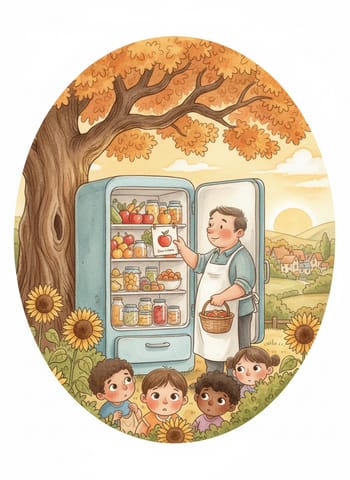
When Guido put a refrigerator outside his shop, he wanted to do something good for the street. He painted it green and wrote "Take what you need, leave what you can" on the door. Neighbors brought vegetables, bread and jars of soup. For the first week, he felt proud every time he walked past it.
Then the problem started. Every morning at about eight, the fridge was almost empty. Guido arrived at half past eight to find one lonely carton of milk and maybe a lemon. The food that people had left the night before was gone.
"Someone is taking everything," he told his wife on the phone. "That is not sharing. That is shopping."
By Thursday, he was angry enough to make a plan. He bought a thick marker and a large piece of card, and he wrote: "ONE ITEM PER PERSON." He was about to tape it to the door when he stopped. He wanted to see the problem with his own eyes before he made a rule for everyone.
On Friday, he came to the shop at half past six. He waited behind the window with a coffee. At ten to eight, a woman arrived with a large cloth bag. A small boy walked beside her, carrying a loaf of bread from home. She looked tired. She opened the fridge, filled the bag carefully, and closed the door as softly as she could.
Guido went outside before she could leave. "Excuse me," he said, sounding sterner than he meant to. "Do you know that other people live on this street too?"
The woman looked at him calmly. "Yes," she said. "That is why I take so much."
Her name was Salome, and she explained everything in a few quiet sentences. Every morning, she carried the food to three neighbors who could not walk to the fridge. One was an old man with a broken hip. The other two were sisters in their eighties. They lived on the fifth floor of a building with no elevator.
"I knock on their doors before I take my son to school," she said. "I thought somebody would tell me to stop."
Guido looked at the card in his hand. It suddenly felt heavy and a little stupid. He folded it in half and put it in his pocket.
"Nobody is going to stop you," he said. "I think I need a different sign."
That afternoon, he wrote a new one. It said: "Take what you need. If you can carry some to a neighbor, thank you." He taped it to the door, and then he went inside to find a bigger bag.