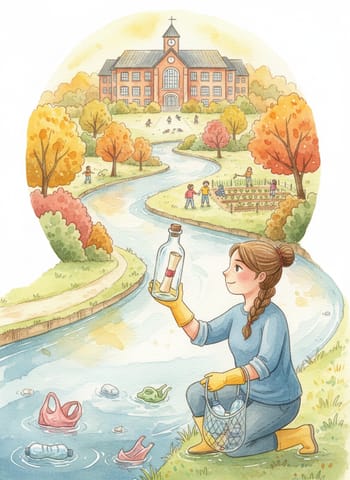
It is a cold Sunday morning. Lale is standing knee-deep in the river with rubber gloves and a black bag. Her neighborhood group holds a cleanup every spring, and this year twenty volunteers have come. So far, they have pulled out tires, a shopping cart, and about two hundred cans.
这是一个寒冷的周日早晨。拉莱戴着橡胶手套,拿着一个黑色垃圾袋,站在齐膝深的河水里。她所在的社区小组每年春天都会举办一次清理活动,今年来了二十位志愿者。到目前为止,他们已经捞出了轮胎、一辆购物车,还有大约两百个易拉罐。
Near a pile of reeds, something small catches the light. It is a plastic bottle, half buried in the mud. Lale almost drops it into the bag with the rest. Then she notices that it isn't empty. There is a folded paper inside, and the cap is wrapped with tape.
在一堆芦苇附近,有个小东西反射出了亮光。那是一个塑料瓶,半埋在泥里。拉莱差点就把它和其他东西一起丢进袋子里。就在这时,她发现瓶子并不是空的。里面有一张折起来的纸,瓶盖还用胶带缠着。
She climbs onto the bank and carefully opens it. The paper is damp but still readable. The handwriting is round and uneven, clearly a child's: "If you find this, write to my school. We want to know how far the river can carry a bottle." Below it are the name of a school and the name of a village.
她爬上河岸,小心地把它打开。纸有些潮,但字迹还能看清。笔迹圆圆的,歪歪扭扭,显然出自一个孩子之手:“如果你捡到了这个,请写信给我们学校。我们想知道河水能把一只瓶子带多远。”下面是一所学校的名字和一个村子的名字。
Lale looks at the map on her phone. The village is about forty kilometers upriver, in the hills. The bottle has traveled all that way, past farms, bridges, and towns, to end up in the mud.
拉莱看着手机上的地图。那个村子在上游大约四十公里的山里。这只瓶子一路漂了那么远,经过农田、桥梁和城镇,最后落在了泥里。
"What did you find?" asks another volunteer.
“你找到了什么?”另一位志愿者问。
"A letter," Lale says. "From a child, in a bottle."
“一封信,”拉莱说,“一个孩子写的,装在瓶子里。”
The volunteer reads it twice. "You have to answer it," he says.
那位志愿者读了两遍。“你一定得回信,”他说。
That evening, Lale sits at her kitchen table with a pen and a clean sheet of paper. She isn't sure what to say. She tells the class where she found the bottle and how far it must have traveled. She explains how much rubbish the river carries. "It goes farther than you think, and so does plastic," she writes. Then she adds, "Would you like us to visit?"
那天傍晚,拉莱坐在厨房的桌前,面前是一支笔和一张干净的纸。她不确定该写些什么。她告诉全班同学她是在哪里发现这只瓶子的,它一定漂了多远。她解释了这条河载着多少垃圾。“它比你们想的漂得更远,塑料也是,”她写道。接着她又加了一句:“你们愿意让我们去拜访吗?”
Ten days later, a reply arrives with a drawing of the river and the signatures of twenty-six students. The teacher has added a line at the bottom: "Please come. The children haven't stopped talking about you."
十天后,一封回信寄到了,里面有一幅河流的图画和二十六名学生的签名。老师在底部加了一行字:“请一定来。孩子们一直在不停地说起你们。”
On a bright Saturday, Lale and six volunteers drive upriver. In the classroom, the children sit on the floor in a half circle. A small girl in the front row raises her hand.
一个晴朗的周六,拉莱和六位志愿者开车驶向上游。教室里,孩子们坐在地板上,围成一个半圆。前排的一个小女孩举起了手。
"Was it my bottle?" she asks.
“那是我的瓶子吗?”她问。
"I think so," Lale says. "It traveled forty kilometers."
“我想是的,”拉莱说,“它漂了四十公里。”
The girl grins.
女孩咧嘴笑了。
They talk for an hour about rubbish, rivers, and what can be recycled. Then everyone walks down to the water behind the school with bags and gloves. The girl from the front row holds a bag open while Lale drops in the first can.
他们谈了一个小时,聊垃圾、河流,还有哪些东西可以回收。然后大家带着袋子和手套,一起走到学校后面的河边。前排的那个女孩撑开一个袋子,拉莱把第一个易拉罐丢了进去。