The Last Leaf
A free B2-level English story for language learners, readable online in 7 languages, with an option to listen via the free Storyteller app.
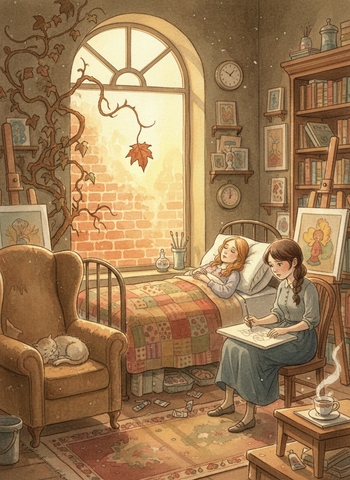
In a shabby Greenwich Village studio, two young painters share a life devoted to art — until one falls gravely ill and ties her hope to the last leaf clinging to a vine outside her window.
In a little district west of Washington Square the streets have run crazy and broken themselves into small strips called “places.” These “places” make strange angles and curves. One street crosses itself a time or two. An artist once discovered a valuable possibility in this street. Suppose a collector with a bill for paints, paper and canvas should, in traversing this route, suddenly meet himself coming back, without a cent having been paid on account!
Num pequeno bairro a oeste da Washington Square, as ruas enlouqueceram e se quebraram em pequenas tiras chamadas “vielas”. Essas “vielas” formam ângulos e curvas estranhas. Uma rua chega a cruzar a si mesma uma ou duas vezes. Certa vez, um artista descobriu uma possibilidade valiosa nessa rua. Suponha que um cobrador, com uma conta de tintas, papel e tela, ao percorrer esse caminho, de repente encontrasse a si mesmo voltando, sem um centavo sequer ter sido pago!
So, to quaint old Greenwich Village the art people soon came prowling, hunting for north windows and eighteenth-century gables and Dutch attics and low rents. Then they imported some pewter mugs and a chafing dish or two from Sixth avenue, and became a “colony.”
Assim, para a pitoresca e antiga Greenwich Village, logo vieram os artistas rondando, em busca de janelas voltadas para o norte, de empenas do século dezoito, de sótãos holandeses e de aluguéis baixos. Depois trouxeram algumas canecas de estanho e uma ou outra travessa de cobre da Sixth Avenue, e se tornaram uma “colônia”.
At the top of a squatty, three-story brick Sue and Johnsy had their studio. “Johnsy” was familiar for Joanna. One was from Maine; the other from California. They had met at the table d’hôte of an Eighth street “Delmonico’s,” and found their tastes in art, chicory salad and bishop sleeves so congenial that the joint studio resulted.
No topo de um prédio de tijolos, baixo e de três andares, Sue e Johnsy tinham seu ateliê. “Johnsy” era o apelido carinhoso de Joanna. Uma era do Maine; a outra, da Califórnia. Tinham se conhecido na mesa d’hôte de um “Delmonico’s” da Eighth Street, e descobriram que seus gostos em arte, em salada de chicória e em mangas de bispo eram tão afins que resultaram no ateliê conjunto.
That was in May. In November a cold, unseen stranger, whom the doctors called Pneumonia, stalked about the colony, touching one here and there with his icy fingers. Over on the east side this ravager strode boldly, smiting his victims by scores, but his feet trod slowly through the maze of the narrow and moss-grown “places.”
Isso foi em maio. Em novembro, um forasteiro frio e invisível, a quem os médicos chamavam de Pneumonia, andava rondando a colônia, tocando um aqui, outro ali, com seus dedos gelados. Do lado leste, esse flagelo avançava com ousadia, atingindo suas vítimas às dezenas, mas seus passos se arrastavam devagar pelo labirinto das “vielas” estreitas e cobertas de musgo.
Mr. Pneumonia was not what you would call a chivalric old gentleman. A mite of a little woman with blood thinned by California zephyrs was hardly fair game for the red-fisted, short-breathed old duffer. But Johnsy he smote; and she lay, scarcely moving, on her painted iron bedstead, looking through the small Dutch window-panes at the blank side of the next brick house.
O Senhor Pneumonia não era o que se poderia chamar de um velho cavalheiro cortês. Uma mulherzinha franzina, de sangue rarefeito pelos ventos brandos da Califórnia, mal era presa digna para aquele velho durão de punhos vermelhos e fôlego curto. Mas Johnsy ele atingiu; e ela ficou deitada, quase sem se mexer, em sua cama de ferro pintado, olhando pelas pequenas vidraças holandesas para a parede cega da casa de tijolos ao lado.
One morning the busy doctor invited Sue into the hallway with a shaggy, gray eyebrow.
Certa manhã, o médico ocupado chamou Sue para o corredor, com uma sobrancelha grisalha e hirsuta.
“She has one chance in—let us say, ten,” he said, as he shook down the mercury in his clinical thermometer. “And that chance is for her to want to live. This way people have of lining-up on the side of the undertaker makes the entire pharmacopeia look silly. Your little lady has made up her mind that she’s not going to get well. Has she anything on her mind?”
— Ela tem uma chance em… digamos, dez — disse ele, enquanto sacudia o mercúrio de seu termômetro clínico. — E essa chance depende de ela querer viver. Esse jeito que as pessoas têm de já se colocar do lado do agente funerário faz toda a farmacopeia parecer ridícula. Sua amiguinha decidiu que não vai ficar boa. Ela tem alguma coisa em mente?
“She—she wanted to paint the Bay of Naples some day,” said Sue.
— Ela… ela queria pintar a Baía de Nápoles um dia — disse Sue.
“Paint?—bosh! Has she anything on her mind worth thinking about twice—a man, for instance?”
— Pintar? Bobagem! Ela tem alguma coisa em mente que valha a pena pensar duas vezes… um homem, por exemplo?
“A man?” said Sue, with a jew’s-harp twang in her voice. “Is a man worth—but, no, doctor; there is nothing of the kind.”
— Um homem? — disse Sue, com um som destoante na voz, como o de uma birimbau. — Será que um homem vale… mas não, doutor; não há nada disso.
“Well, it is the weakness, then,” said the doctor. “I will do all that science, so far as it may filter through my efforts, can accomplish. But whenever my patient begins to count the carriages in her funeral procession I subtract 50 per cent. from the curative power of medicines. If you will get her to ask one question about the new winter styles in cloak sleeves I will promise you a one-in-five chance for her, instead of one in ten.”
— Bem, então é a fraqueza — disse o médico. — Farei tudo o que a ciência, na medida em que possa se filtrar através dos meus esforços, puder realizar. Mas sempre que minha paciente começa a contar as carruagens do próprio cortejo fúnebre, eu subtraio cinquenta por cento do poder curativo dos remédios. Se a senhorita conseguir que ela pergunte alguma coisa sobre as novas modas de inverno para mangas de capa, eu prometo uma chance em cinco para ela, em vez de uma em dez.
After the doctor had gone Sue went into the workroom and cried a Japanese napkin to a pulp. Then she swaggered into Johnsy’s room with her drawing board, whistling ragtime.
Depois que o médico saiu, Sue foi para o quarto de trabalho e chorou até transformar um guardanapo japonês numa polpa encharcada. Depois, entrou decidida no quarto de Johnsy com sua prancheta de desenho, assobiando ragtime.
Johnsy lay, scarcely making a ripple under the bedclothes, with her face toward the window. Sue stopped whistling, thinking she was asleep.
Johnsy estava deitada, quase sem fazer ondulação nenhuma sob as cobertas, com o rosto voltado para a janela. Sue parou de assobiar, pensando que ela estivesse dormindo.
She arranged her board and began a pen-and-ink drawing to illustrate a magazine story. Young artists must pave their way to Art by drawing pictures for magazine stories that young authors write to pave their way to Literature.
Ela ajeitou sua prancheta e começou um desenho a nanquim para ilustrar um conto de revista. Jovens artistas precisam pavimentar seu caminho para a Arte desenhando ilustrações para contos de revista que jovens escritores escrevem para pavimentar o próprio caminho para a Literatura.
As Sue was sketching a pair of elegant horseshow riding trousers and a monocle on the figure of the hero, an Idaho cowboy, she heard a low sound, several times repeated. She went quickly to the bedside.
Enquanto Sue esboçava um belo par de calças de montaria de exibição e um monóculo na figura do herói, um vaqueiro de Idaho, ela ouviu um som baixo, repetido várias vezes. Foi depressa até a cabeceira da cama.
Johnsy’s eyes were open wide. She was looking out the window and counting—counting backward.
Os olhos de Johnsy estavam bem abertos. Ela olhava pela janela e contava… contava ao contrário.
“Twelve,” she said, and a little later “eleven;” and then “ten,” and “nine;” and then “eight” and “seven,” almost together.
— Doze — disse ela, e um pouco depois “onze”; depois “dez” e “nove”; e então “oito” e “sete”, quase juntos.
Sue looked solicitously out the window. What was there to count? There was only a bare, dreary yard to be seen, and the blank side of the brick house twenty feet away. An old, old ivy vine, gnarled and decayed at the roots, climbed half way up the brick wall. The cold breath of autumn had stricken its leaves from the vine until its skeleton branches clung, almost bare, to the crumbling bricks.
Sue olhou pela janela, preocupada. O que havia ali para contar? Só se via um quintal nu e sombrio, e a parede cega da casa de tijolos a seis metros de distância. Uma velha, velhíssima trepadeira de hera, nodosa e apodrecida na raiz, subia até a metade da parede de tijolos. O sopro frio do outono havia arrancado suas folhas até que os galhos esqueléticos, quase nus, se agarrassem aos tijolos desmoronados.
“What is it, dear?” asked Sue.
— O que é, querida? — perguntou Sue.
“Six,” said Johnsy, in almost a whisper. “They’re falling faster now. Three days ago there were almost a hundred. It made my head ache to count them. But now it’s easy. There goes another one. There are only five left now.”
— Seis — disse Johnsy, quase num sussurro. — Estão caindo mais depressa agora. Três dias atrás havia quase cem. Doía a cabeça de tanto contar. Mas agora é fácil. Lá vai mais uma. Só sobram cinco agora.
“Five what, dear. Tell your Sudie.”
— Cinco o quê, querida. Conta pra sua Sudie.
“Leaves. On the ivy vine. When the last one falls I must go, too. I’ve known that for three days. Didn’t the doctor tell you?”
— Folhas. Na trepadeira de hera. Quando a última cair, eu também terei que ir. Já sei disso há três dias. O médico não te contou?
“Oh, I never heard of such nonsense,” complained Sue, with magnificent scorn. “What have old ivy leaves to do with your getting well? And you used to love that vine so, you naughty girl. Don’t be a goosey. Why, the doctor told me this morning that your chances for getting well real soon were—let’s see exactly what he said—he said the chances were ten to one!
— Ah, nunca ouvi uma bobagem dessas — reclamou Sue, com desdém magnífico. — O que é que as folhas velhas de hera têm a ver com você ficar boa? E você adorava tanto essa trepadeira, sua menina levada. Não seja boba. Ora, o médico me disse hoje de manhã que suas chances de ficar boa logo eram… deixa eu ver exatamente o que ele disse… ele disse que as chances eram de dez para um!
“Why, that’s almost as good a chance as we have in New York when we ride on the street cars or walk past a new building. Try to take some broth now, and let Sudie go back to her drawing, so she can sell the editor man with it, and buy port wine for her sick child, and pork chops for her greedy self.”
— Ora, isso é quase uma chance tão boa quanto a que temos aqui em Nova York quando andamos de bonde ou passamos perto de um prédio em construção. Tenta tomar um caldo agora, e deixa a Sudie voltar ao desenho dela, pra que ela possa vender pro homem da redação, e comprar vinho do porto pra sua doentinha, e costeletas de porco pra ela mesma, gulosa que é.
“You needn’t get any more wine,” said Johnsy, keeping her eyes fixed out the window. “There goes another. No, I don’t want any broth. That leaves just four. I want to see the last one fall before it gets dark. Then I’ll go, too.”
— Você não precisa comprar mais vinho — disse Johnsy, mantendo os olhos fixos na janela. — Lá vai mais uma. Não, não quero caldo nenhum. Isso deixa só quatro. Quero ver a última cair antes de escurecer. Aí eu também vou.
“Johnsy, dear,” said Sue, bending over her, “will you promise me to keep your eyes closed, and not look out the window until I am done working? I must hand those drawings in by to-morrow. I need the light, or I would draw the shade down.”
— Johnsy, querida — disse Sue, debruçando-se sobre ela —, você promete manter os olhos fechados, e não olhar pela janela até eu terminar de trabalhar? Preciso entregar esses desenhos amanhã. Preciso da luz, senão eu baixaria a cortina.
“Couldn’t you draw in the other room?” asked Johnsy, coldly.
— Você não podia desenhar no outro quarto? — perguntou Johnsy, friamente.
“I’d rather be here by you,” said Sue. “Besides I don’t want you to keep looking at those silly ivy leaves.”
— Prefiro ficar aqui com você — disse Sue. — Além disso, não quero que você fique olhando pra essas folhas de hera bobas.
“Tell me as soon as you have finished,” said Johnsy, closing her eyes, and lying white and still as a fallen statue, “because I want to see the last one fall. I’m tired of waiting. I’m tired of thinking. I want to turn loose my hold on everything, and go sailing down, down, just like one of those poor, tired leaves.”
— Me avisa assim que terminar — disse Johnsy, fechando os olhos, e deitada branca e imóvel como uma estátua caída —, porque eu quero ver a última cair. Estou cansada de esperar. Estou cansada de pensar. Quero soltar minhas amarras de tudo, e ir navegando para baixo, para baixo, igual a uma daquelas pobres folhas cansadas.
“Try to sleep,” said Sue. “I must call Behrman up to be my model for the old hermit miner. I’ll not be gone a minute. Don’t try to move ’till I come back.”
— Tenta dormir — disse Sue. — Preciso chamar o Behrman pra ser meu modelo do velho eremita minerador. Não vou demorar nem um minuto. Não tente se mexer até eu voltar.
Old Behrman was a painter who lived on the ground floor beneath them. He was past sixty and had a Michael Angelo’s Moses beard curling down from the head of a satyr along the body of an imp. Behrman was a failure in art. Forty years he had wielded the brush without getting near enough to touch the hem of his Mistress’s robe. He had been always about to paint a masterpiece, but had never yet begun it. For several years he had painted nothing except now and then a daub in the line of commerce or advertising.
O velho Behrman era um pintor que morava no andar térreo, embaixo delas. Já havia passado dos sessenta e tinha uma barba de Moisés de Michelangelo, encaracolada, descendo de uma cabeça de sátiro ao longo de um corpo de duende. Behrman era um fracasso na arte. Havia quarenta anos maneja va o pincel sem chegar sequer perto de tocar a bainha do manto de sua Musa. Estava sempre prestes a pintar uma obra-prima, mas nunca a havia sequer começado. Fazia anos que não pintava nada além de, vez ou outra, algum rabisco em linha de comércio ou publicidade.
He earned a little by serving as a model to those young artists in the colony who could not pay the price of a professional. He drank gin to excess, and still talked of his coming masterpiece. For the rest he was a fierce little old man, who scoffed terribly at softness in any one, and who regarded himself as especial mastiff-in-waiting to protect the two young artists in the studio above.
Ganhava um pouco servindo de modelo para aqueles jovens artistas da colônia que não podiam pagar o preço de um profissional. Bebia gim em excesso, e ainda assim falava de sua obra-prima por vir. Fora isso, era um velhinho feroz, que zombava terrivelmente de qualquer sinal de fraqueza em alguém, e que se considerava uma espécie de mastim de guarda especial, encarregado de proteger as duas jovens artistas do ateliê lá em cima.
Sue found Behrman smelling strongly of juniper berries in his dimly lighted den below. In one corner was a blank canvas on an easel that had been waiting there for twenty-five years to receive the first line of the masterpiece. She told him of Johnsy’s fancy, and how she feared she would, indeed, light and fragile as a leaf herself, float away when her slight hold upon the world grew weaker.
Sue encontrou Behrman, cheirando fortemente a zimbro, em seu covil mal iluminado. Num canto havia uma tela em branco sobre um cavalete, que esperava havia vinte e cinco anos para receber a primeira linha da obra-prima. Ela lhe contou da fantasia de Johnsy, e de como temia que ela, leve e frágil como uma folha, de fato fosse flutuar para longe quando seu tênue laço com o mundo enfraquecesse ainda mais.
Old Behrman, with his red eyes plainly streaming, shouted his contempt and derision for such idiotic imaginings.
O velho Behrman, com seus olhos vermelhos claramente marejados, gritou seu desprezo e escárnio por semelhante ideia idiota.
“Vass!” he cried. “Is dere people in de world mit der foolishness to die because leafs dey drop off from a confounded vine? I haf not heard of such a thing. No, I will not bose as a model for your fool hermit-dunderhead. Vy do you allow dot silly pusiness to come in der prain of her? Ach, dot poor lettle Miss Johnsy.”
— Vass! — gritou ele. — Existe gente no mundo com a tolice de morrer porque folhas caem de uma trepadeira maldita? Nunca ouvi falar de coisa assim. Não, não vou posar de modelo pro seu tolo eremita-cabeça-oca. Por que você deixa essa bobagem entrar na cabeça dela? Ah, aquela pobre pequena senhorita Johnsy.
“She is very ill and weak,” said Sue, “and the fever has left her mind morbid and full of strange fancies. Very well, Mr. Behrman, if you do not care to pose for me, you needn’t. But I think you are a horrid old—old flibbertigibbet.”
— Ela está muito doente e fraca — disse Sue —, e a febre deixou a mente dela mórbida e cheia de fantasias estranhas. Muito bem, senhor Behrman, se não quiser posar pra mim, não precisa. Mas acho que o senhor é um horrível… velho tagarela sem juízo.
“You are just like a woman!” yelled Behrman. “Who said I will not bose? Go on. I come mit you. For half an hour I haf peen trying to say dot I am ready to bose. Gott! dis is not any blace in which one so goot as Miss Yohnsy shall lie sick. Some day I vill baint a masterpiece, and ve shall all go away. Gott! yes.”
— Você é igualzinha a uma mulher! — gritou Behrman. — Quem disse que eu não vou posar? Vamos. Eu vou com você. Já faz meia hora que eu tento dizer que estou pronto pra posar. Deus! Este não é lugar nenhum pra uma pessoa tão boa quanto a senhorita Yohnsy ficar doente. Um dia eu vou pintar uma obra-prima, e todos nós vamos embora daqui. Deus! Sim.
Johnsy was sleeping when they went upstairs. Sue pulled the shade down to the window-sill, and motioned Behrman into the other room. In there they peered out the window fearfully at the ivy vine. Then they looked at each other for a moment without speaking. A persistent, cold rain was falling, mingled with snow. Behrman, in his old blue shirt, took his seat as the hermit-miner on an upturned kettle for a rock.
Johnsy estava dormindo quando eles subiram. Sue baixou a cortina até o parapeito da janela, e fez sinal para Behrman ir para o outro quarto. Lá dentro, espiaram pela janela com medo, olhando para a trepadeira de hera. Depois se entreolharam por um momento, sem falar. Chovia sem parar, uma chuva fria misturada com neve. Behrman, em sua velha camisa azul, sentou-se no papel de eremita-minerador, sobre um caldeirão virado que fazia as vezes de rocha.
When Sue awoke from an hour’s sleep the next morning she found Johnsy with dull, wide-open eyes staring at the drawn green shade.
Quando Sue acordou de uma hora de sono, na manhã seguinte, encontrou Johnsy com os olhos abertos, opacos e fixos, olhando para a cortina verde baixada.
“Pull it up; I want to see,” she ordered, in a whisper.
— Levanta ela; eu quero ver — ordenou ela, num sussurro.
Wearily Sue obeyed.
Cansada, Sue obedeceu.
But, lo! after the beating rain and fierce gusts of wind that had endured through the livelong night, there yet stood out against the brick wall one ivy leaf. It was the last on the vine. Still dark green near its stem, but with its serrated edges tinted with the yellow of dissolution and decay, it hung bravely from a branch some twenty feet above the ground.
Mas, eis que, depois da chuva batendo e das rajadas ferozes de vento que haviam durado a noite inteira, ainda se destacava contra a parede de tijolos uma folha de hera. Era a última na trepadeira. Ainda verde-escura perto do caule, mas com as bordas serrilhadas tingidas do amarelo da dissolução e da decadência, pendia bravamente de um galho a uns seis metros do chão.
“It is the last one,” said Johnsy. “I thought it would surely fall during the night. I heard the wind. It will fall to-day, and I shall die at the same time.”
— É a última — disse Johnsy. — Eu achei que ela ia cair com certeza durante a noite. Ouvi o vento. Vai cair hoje, e eu vou morrer junto com ela.
“Dear, dear!” said Sue, leaning her worn face down to the pillow, “think of me, if you won’t think of yourself. What would I do?”
— Ai, querida, querida! — disse Sue, curvando o rosto cansado sobre o travesseiro. — Pensa em mim, já que não quer pensar em você mesma. O que é que eu faço?
But Johnsy did not answer. The lonesomest thing in all the world is a soul when it is making ready to go on its mysterious, far journey. The fancy seemed to possess her more strongly as one by one the ties that bound her to friendship and to earth were loosed.
Mas Johnsy não respondeu. A coisa mais solitária no mundo inteiro é uma alma quando se prepara para partir em sua misteriosa e longa viagem. A fantasia parecia dominá-la cada vez mais, à medida que, um por um, os laços que a prendiam à amizade e à terra iam se soltando.
The day wore away, and even through the twilight they could see the lone ivy leaf clinging to its stem against the wall. And then, with the coming of the night the north wind was again loosed, while the rain still beat against the windows and pattered down from the low Dutch eaves.
O dia se foi passando, e mesmo já no crepúsculo elas ainda conseguiam ver a folha de hera solitária, presa ao caule contra a parede. E então, com a chegada da noite, o vento norte se soltou de novo, enquanto a chuva ainda batia nas janelas e pingava dos beirais holandeses baixos.
When it was light enough Johnsy, the merciless, commanded that the shade be raised.
Quando já havia luz suficiente, Johnsy, impiedosa, mandou que levantassem a cortina.
The ivy leaf was still there.
A folha de hera ainda estava lá.
Johnsy lay for a long time looking at it. And then she called to Sue, who was stirring her chicken broth over the gas stove.
Johnsy ficou olhando para ela por um longo tempo. E então chamou Sue, que mexia seu caldo de galinha no fogão a gás.
“I’ve been a bad girl, Sudie,” said Johnsy. “Something has made that last leaf stay there to show me how wicked I was. It is a sin to want to die. You may bring me a little broth now, and some milk with a little port in it, and—no; bring me a hand-mirror first, and then pack some pillows about me, and I will sit up and watch you cook.”
— Eu tenho sido uma menina má, Sudie — disse Johnsy. — Alguma coisa fez com que aquela última folha ficasse ali, para me mostrar como eu fui má. É pecado querer morrer. Você pode me trazer um pouco de caldo agora, e um pouco de leite com um pouquinho de vinho do porto dentro, e… não; me traz um espelho de mão primeiro, e depois arruma umas almofadas ao meu redor, e eu vou sentar e ficar olhando você cozinhar.
An hour later she said.
Uma hora depois, ela disse:
“Sudie, some day I hope to paint the Bay of Naples.”
— Sudie, um dia eu espero pintar a Baía de Nápoles.
The doctor came in the afternoon, and Sue had an excuse to go into the hallway as he left.
O médico veio à tarde, e Sue arranjou um motivo para ir ao corredor quando ele saiu.
“Even chances,” said the doctor, taking Sue’s thin, shaking hand in his. “With good nursing you’ll win. And now I must see another case I have downstairs. Behrman, his name is—some kind of an artist, I believe. Pneumonia, too. He is an old, weak man, and the attack is acute. There is no hope for him; but he goes to the hospital to-day to be made more comfortable.”
— Chances iguais — disse o médico, segurando a mão fina e trêmula de Sue na dele. — Com bons cuidados, você vai ganhar. E agora preciso ver outro caso que tenho lá embaixo. Behrman, o nome dele… algum tipo de artista, eu acho. Pneumonia, também. É um homem velho e fraco, e a crise é aguda. Não há esperança pra ele; mas ele vai pro hospital hoje, pra ficar mais confortável.
The next day the doctor said to Sue: “She’s out of danger. You’ve won. Nutrition and care now—that’s all.”
No dia seguinte, o médico disse a Sue: — Ela está fora de perigo. Você ganhou. Nutrição e cuidados agora… é só isso.
And that afternoon Sue came to the bed where Johnsy lay, contentedly knitting a very blue and very useless woolen shoulder scarf, and put one arm around her, pillows and all.
E naquela tarde, Sue foi até a cama onde Johnsy estava deitada, tricotando contente um cachecol de lã bem azul e completamente inútil, e passou um braço em volta dela, almofadas e tudo.
“I have something to tell you, white mouse,” she said. “Mr. Behrman died of pneumonia to-day in the hospital. He was ill only two days. The janitor found him on the morning of the first day in his room downstairs helpless with pain. His shoes and clothing were wet through and icy cold. They couldn’t imagine where he had been on such a dreadful night.
— Tenho uma coisa pra te contar, camundonguinha branca — disse ela. — O senhor Behrman morreu de pneumonia hoje, no hospital. Ele ficou doente só dois dias. O zelador o encontrou na manhã do primeiro dia, no quarto dele lá embaixo, indefeso de dor. Os sapatos e as roupas dele estavam encharcados e gelados. Não conseguiam imaginar onde ele tinha estado numa noite tão terrível.
“And then they found a lantern, still lighted, and a ladder that had been dragged from its place, and some scattered brushes, and a palette with green and yellow colors mixed on it, and—look out the window, dear, at the last ivy leaf on the wall. Didn’t you wonder why it never fluttered or moved when the wind blew? Ah, darling, it’s Behrman’s masterpiece—he painted it there the night that the last leaf fell.”
— E aí encontraram uma lanterna, ainda acesa, e uma escada que tinha sido arrastada de seu lugar, e alguns pincéis espalhados, e uma paleta com tintas verde e amarela misturadas nela, e… olha pela janela, querida, pra última folha de hera na parede. Você nunca se perguntou por que ela nunca tremia ou se mexia quando o vento soprava? Ah, querida, essa é a obra-prima de Behrman… ele a pintou ali na noite em que a última folha caiu.
