Sweet Porridge
A free A2-level English story for language learners, readable online in 7 languages, with an option to listen via the free Storyteller app.
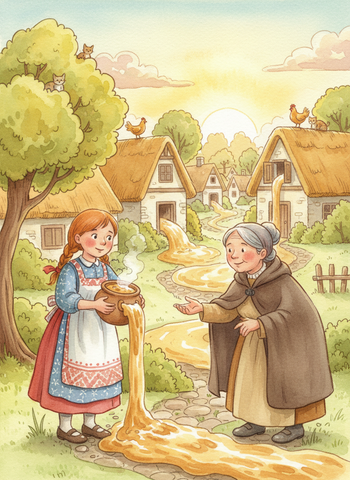
A kind girl is given a magic pot that cooks porridge at two magic words — but what happens when someone forgets how to make it stop?
There was once a poor widow who had only one daughter, a child who was so good and gentle that everyone who knew her, loved her.
Era uma vez uma pobre viúva que tinha apenas uma filha, uma menina tão boa e gentil que todos que a conheciam a amavam.
One day the child went into the forest to gather firewood, and she was very sad because there was nothing left in the house to eat, and because she and her mother were so often obliged to go hungry.
Um dia a menina foi à floresta buscar lenha, e estava muito triste porque não havia mais nada para comer em casa, e porque ela e sua mãe eram tantas vezes obrigadas a passar fome.
She had already gathered a bundle of sticks, and was about to go home, when she saw a poor old woman who had also come to the forest for wood. The woman was so bent and stiff that it was pitiful to see her. The child felt sorry for her and wished to help her.
Ela já tinha juntado um feixe de gravetos e estava prestes a voltar para casa quando viu uma pobre velhinha que também tinha ido à floresta buscar lenha. A mulher estava tão curvada e rígida que dava pena vê-la. A menina sentiu pena dela e quis ajudá-la.
“Good mother,” said she, “let me gather the wood for you; it must be hard for you to stoop.”
“Boa mulher”, disse ela, “deixe que eu junte a lenha para a senhora; deve ser difícil para a senhora se abaixar.”
She put down her own load, and gathered for the old woman as much as she was able to carry. “I would take it home for you,” said the little girl, “but my mother is waiting for me, and I must make haste, for I am already late.”
Ela largou sua própria carga e juntou para a velhinha tanta lenha quanto conseguiu carregar. “Eu levaria isso até sua casa”, disse a menina, “mas minha mãe está me esperando, e preciso me apressar, pois já estou atrasada.”
“Child,” said the old woman, “you have a good heart, and you deserve to be rewarded.” She then drew out from under her cloak a little iron pot. “Take this,” she said. “It is a magic pot. Whenever you are hungry you have only to say—
“Menina”, disse a velha, “você tem um bom coração, e merece ser recompensada.” Ela então tirou de debaixo de sua capa uma pequena panela de ferro. “Pegue isto”, disse ela. “É uma panela mágica. Sempre que você estiver com fome, basta dizer—
“‘Boil little pot Till the porridge is hot,’
“‘Ferva, panelinha, Até o mingau ficar quente,’
and it will begin to boil and fill up with sweet porridge. When you have had enough say—
e ela começará a ferver e se encherá de mingau doce. Quando você tiver comido o suficiente, diga—
“‘Cease little pot, The porridge is hot,’
“‘Pare, panelinha, O mingau está quente,’
and it will stop boiling.”
e ela parará de ferver.”
She made the child repeat the words after her several times, and she then gave her the pot and hobbled away through the forest.
Ela fez a menina repetir as palavras várias vezes, e então lhe entregou a panela e se afastou mancando pela floresta.
The child was filled with joy at the thought that now she and her mother need never be hungry again. She ran home as fast as she could, carrying the pot with both hands.
A menina ficou cheia de alegria ao pensar que agora ela e sua mãe nunca mais precisariam passar fome. Correu para casa o mais depressa que pôde, carregando a panela com as duas mãos.
When she came in her mother asked her where the wood was.
Quando entrou, sua mãe perguntou onde estava a lenha.
“I have brought home something better than wood,” cried the child. “The wood only warms us, but here is something that will feed us as well.” She set the pot upon the table and said:
“Eu trouxe para casa algo melhor do que lenha”, exclamou a menina. “A lenha só nos aquece, mas aqui está algo que também vai nos alimentar.” Ela colocou a panela sobre a mesa e disse:
“Boil little pot Till the porridge is hot.”
“Ferva, panelinha, Até o mingau ficar quente.”
The pot at once began to bubble and boil, and soon it was full and brimming over with sweet porridge. The widow caught up a spoon and dipped some of the porridge out into a bowl, but the more she dipped out the more there was in it. When all the bowls in the house were full, the child said:
A panela imediatamente começou a borbulhar e ferver, e logo estava cheia e transbordando de mingau doce. A viúva pegou uma colher e tirou um pouco de mingau para uma tigela, mas quanto mais tirava, mais havia dentro da panela. Quando todas as tigelas da casa estavam cheias, a menina disse:
“Cease little pot, The porridge is hot,”
“Pare, panelinha, O mingau está quente,”
and at once the pot stopped boiling.
e a panela parou de ferver imediatamente.
The widow was overjoyed at the treasure the little girl had brought home. “Come,” cried she, “let us sit down and eat.”
A viúva ficou radiante com o tesouro que a menina tinha trazido para casa. “Venha”, exclamou ela, “vamos nos sentar e comer.”
“Yes, dear mother,” said the child, “but first I will carry some of the porridge to the neighbors who were so kind to us when we had nothing.”
“Sim, querida mãe”, disse a menina, “mas primeiro vou levar um pouco de mingau para os vizinhos que foram tão gentis conosco quando não tínhamos nada.”
She filled a large kettle with porridge and started out with it, but no sooner had she gone than the widow began to wonder whether they had kept enough for themselves. She did not feel satisfied, so she said to the pot:
Ela encheu uma grande vasilha com mingau e saiu com ela, mas mal tinha ido embora quando a viúva começou a se perguntar se tinham guardado o suficiente para elas mesmas. Não ficou satisfeita, então disse à panela:
“Boil little pot Till the porridge is hot.”
“Ferva, panelinha, Até o mingau ficar quente.”
Immediately the pot began to bubble and boil. Soon it was full and the porridge began to run over. The widow wished to stop it, but she had forgotten what to say. “Enough!” she cried. “Stop! Stop!” but the porridge still boiled up and over the edge of the pot. The widow caught up the spoon and again began dipping out the porridge; she dipped as fast as she could. Soon all the pots and pans in the house were full and still the pot continued to boil out porridge. In despair the widow seized the pot and threw it outside the door, but the porridge flowed out from it in a stream, and ran down the road.
Imediatamente a panela começou a borbulhar e ferver. Logo estava cheia e o mingau começou a transbordar. A viúva quis pará-la, mas tinha esquecido o que dizer. “Basta!”, gritou ela. “Pare! Pare!” — mas o mingau continuava fervendo e transbordando pela borda da panela. A viúva pegou a colher e começou de novo a tirar o mingau; tirava o mais rápido que podia. Logo todas as panelas e vasilhas da casa estavam cheias, e ainda assim a panela continuava a ferver e a produzir mingau. Em desespero, a viúva agarrou a panela e a jogou para fora da porta, mas o mingau saía dela em um riacho e escorria pela estrada.
The little girl was coming home when she met the stream of porridge, and at once she guessed what had happened. She ran as fast as she could and when she came to the place where the pot lay she cried:
A menina estava voltando para casa quando encontrou o riacho de mingau, e logo adivinhou o que tinha acontecido. Correu o mais rápido que pôde e, quando chegou ao lugar onde a panela estava caída, gritou:
“Cease little pot, The porridge is hot.”
“Pare, panelinha, O mingau está quente.”
At once the pot stopped boiling, but already enough porridge had been wasted to have fed the whole countryside.
No mesmo instante a panela parou de ferver, mas já se tinha desperdiçado mingau suficiente para alimentar toda a região.
After that the widow never again dared to tell the pot to boil. When they wished for porridge it was the child who spoke to it. But from then on she and her mother never lacked for anything, for the porridge was so delicious that people came from far and near to buy from them.
Depois disso, a viúva nunca mais ousou mandar a panela ferver. Quando queriam mingau, era a menina quem falava com ela. Mas, a partir de então, nunca mais lhes faltou nada, pois o mingau era tão delicioso que vinha gente de perto e de longe para comprá-lo.
