The Wrong Label in the Gallery
A free B2-level English story for language learners, readable online in 4 languages, with an option to listen via the free Storyteller app.
A museum intern spots a tiny signature that contradicts a painting's label and must persuade a doubtful curator to take another look.
That was the preview! Hear the full story in the free Storyteller app. Get the app
Audio isn't available right now.
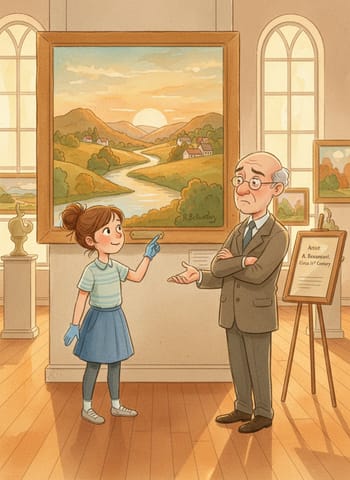
Eugenie had been working at the museum for eleven weeks when she began to doubt a painting. It hung in the second gallery, a small oil of a tidal river at dusk. The label beside it read: "Attributed to the Master of the Grey Estuary, c. 1840."
She passed it every morning on her way to the archive. Only during a lighting check, with a cloth in her hand, did she notice the mark in the lower corner. It was a tiny fish, drawn in two curved strokes, no longer than a grain of rice.
Nobody knew who the Master of the Grey Estuary really was. Scholars had invented the name because none of his paintings were signed. A signature, then, should not have been there at all.
In the east wing, however, hung a harbor scene by a painter who put a small fish on every canvas. Eugenie stood in front of it for ten minutes. The skies matched: both were built from short, dry dabs of paint rather than smooth blending.
She photographed both corners through a magnifying lens and spent two afternoons in the archive. In a box of unsorted papers she found a dealer's receipt dated 1843. It listed "one estuary view at dusk, small, signed with the fish," sold for three marks.
Lennart, the senior curator, had run the gallery for twenty years. He listened to her with his arms crossed.
"That label has been on the wall for sixty years," he said. "People far more experienced than you have walked past that painting."
"I know," Eugenie said. "But if I were wrong, checking would cost us one afternoon."
"A fish could mean anything. Half the painters of that period doodled in the corners."
"Perhaps. However, the receipt says 'signed with the fish,' and the date agrees with the conservation report." She slid the photographs across the desk. "Someone must have looked at this before, but nobody wrote it down."
Lennart said that the museum would look foolish if it changed the label and then had to change it back. Eugenie answered that it would look much more foolish to keep a wrong one after being shown the evidence.
Neither of them spoke for a while. Down the corridor, a cart rattled past, and a school group was being led toward the east wing.
At last, Lennart held out his hand. "Give me the lens," he said.
He bent over the photographs for a long time. Then he walked into the gallery, lifted the old label off its hook and turned it over. On the back, in pencil, he wrote: "Fish. See receipt, 1843."
"Now get me the other file," he said. "And bring a second chair. If we are going to do this, we should do it properly."