The Translation Lag
A free C1-level English story for language learners, readable online in 7 languages, with an option to listen via the free Storyteller app.
A teenager given a real-time translation earpiece for family dinners realizes the device's small delay is costing her something the accurate words alone can't replace.
That was the preview! Hear the full story in the free Storyteller app. Get the app
Audio isn't available right now.
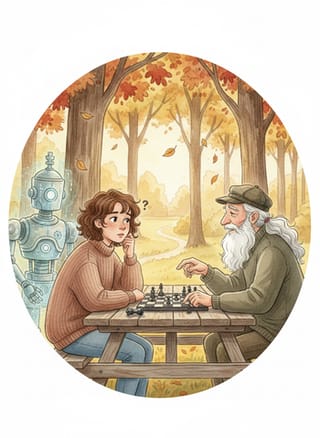
Dara had been given the earpiece for Sunday dinners specifically, after her mother noticed how much of the table conversation she was quietly missing. It translated in both directions, near enough to real time that the app's marketing had called it "invisible," and for the first few weeks it genuinely felt that way. Her grandmother would say something in the language Dara had let slip through her fingers somewhere around age eleven. Half a second later, Dara would hear it in English, warm and clear, right in her own ear.
What the marketing hadn't mentioned was the half second itself.
It was barely a delay — less than the length of a breath — but it was enough, Dara started to notice, to put her permanently one beat behind everyone else at the table. Her cousins would laugh at something her grandmother said. Dara's translation would arrive just after, so that her own laugh always landed a fraction late, isolated, its own small event rather than part of the group's. Worse were the moments that depended entirely on timing — a joke that needed an instant reaction, an old story her grandmother told with a pause built in for someone to guess the ending. By the time the words reached Dara, the pause had already closed.
Had the lag simply not existed, she might never have noticed anything at all beyond gratitude for finally understanding her grandmother again. Because it did exist, she began to notice something else instead: that understanding the words was not, on its own, the same thing as being present for the moment they were spoken in.
She raised it with her mother only once, half-joking, and her mother's answer surprised her. "Your grandmother knows more English than she lets that earpiece translate for," she said. "She's not hiding it. She just prefers to say things in her own words and let you come to them, rather than have a machine hand them to you finished."
Dara thought about that for most of the following week — about a grandmother who had, perhaps, been waiting all along for Dara to meet her halfway rather than be delivered to her fully translated. On the next Sunday, she left the earpiece in its case beside her plate.
What followed was not fluent. Dara's sentences came out lopsided, missing half their grammar, propped up by gestures and the dozen or so words that had never quite left her. Her grandmother didn't switch to English or reach for her own phone to help. She slowed down instead, repeating a phrase twice, waiting the way she must once have waited for a much younger Dara to catch up. It took nearly a minute to establish that the story was about a bicycle. Neither of them minded. For the first time in months, the laugh, when it came, arrived exactly on time.