The Story of the Beginning
A free B2-level English story for language learners, readable online in 7 languages, with an option to listen via the free Storyteller app.
Long before they knew the one true God, the peoples of the north imagined gods and giants behind the sun, the storms, and the sky — and told of ice, fire, and the rise of Asgard and Midgard.
That was the preview! Hear the full story in the free Storyteller app. Get the app
Audio isn't available right now.
The people who lived long ago, in the far-off lands of the north, watched the wonderful things that happened out of doors every day, just as we do; but they did not know about the one loving God, who is the Father of all, who made them and the world, and rules it by his wise laws; so they thought there must be a great many unseen powers, living in the clouds, in the wind, in the storms, and the sunshine, and doing all those wonders that no man could do.
And so those northern people, who were our own forefathers, came to believe in many gods—one for the sun, another for the thunder, another for the flowers, and so on.
In the long, dark winters, when the bright sun had gone away from them, these northmen had time to think many thoughts about the powers of frost, and wind, and storms, which they called giants, and they used to tell stories and sing songs about the short, bright summer, the thawing out of the streams and lakes, the coming of the birds and flowers.
With great joy the people saw the bright sun-god, Baldur, come back to them in the spring, after the long darkness, and knew that they owed their lives to his friendly warmth and light.
As we read the stories, or myths, told by those people long ago, we can see that they were meant to tell about the world around us. At first the stories were told and sung from father to son—that is, from one generation to another; but later, when people learned how to write, these myths were written down, and kept with great love and care.
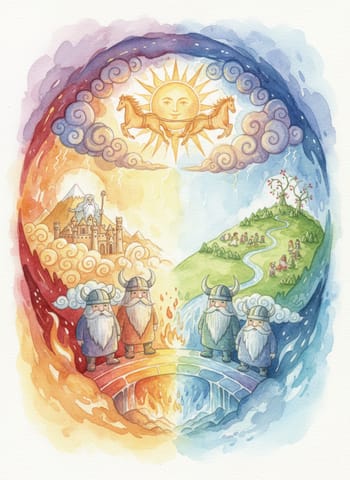
This is the story they told of the Beginning. At first, before living creatures were in the world, it was all rough and without order. Far to the north it was very cold, for ice and snow were everywhere. Toward the south there was fire, and from the meeting of the fire and the cold a thick vapor was formed, from which sprang a huge giant. On looking about for some food, he saw a cow, who was also searching for something to eat. The ice tasted salt, and when the cow began to lick it, a head appeared, and at last the whole figure of a god stood before her.
From these two, the giant and the god, came the two great races of giants and gods, who were always enemies to each other. The giants were constantly trying to break into Asgard, the home of the gods, in the sky; the gods, on the other hand, watched and planned to keep out the giants, and to drive them back to their own stronghold, Utgard. Our world, where men and women lived, was between Utgard and Asgard; it was called Midgard, and around this Midgard world, under the ocean, was coiled a monstrous serpent, who grew so long that his tail grew down his throat. He was called the Midgard serpent.
A wonderful tree, named "Yggdrasil," connected all the worlds. This great ash tree had its roots in Utgard, and the tops of its branches reached up so high as to overshadow Asgard. Its three main roots were watered by three fountains, and near one of them sat the wise giant Mimir, of whom we shall hear later. The Norns, three sisters, also lived at the roots of Yggdrasil, and were careful to see that it was watered every day.
A little gray squirrel was always running up and down the tree, jerking his tail and hurrying to tell the news to every one along the way. He was so anxious to be the first one to carry the news, that many times he brought trouble to himself and to others, because he was not always careful to tell a story just as he had heard it, and often every one would have been happier if the squirrel had kept the story quite to himself.
The gods and goddesses, all together, were called the Aesir, and the chief and father of them all was Odin. His lofty throne rose high in the midst of Asgard, the sacred city, which the gods had built for their beautiful home.
From Asgard, arching over and down to the lower world, was a rainbow bridge, called Bifröst—"the trembling bridge"; upon this the dwellers in Asgard could travel every day, all except the mighty Thor. His thunder chariot was too heavy for "the trembling bridge," so he had to go around a longer way.
After the gods had made men and women, and had taught them to dwell on the earth, in the world of Midgard, Odin looked forth one morning from his heavenly seat, to see what further work was waiting for his helping hand.
He noticed, far away below him, a race of small beings, some of them busy, doing mischievous deeds, while others sat idle, doing nothing. Odin sent for all these little people to come to him, and when they had reached Asgard, and were admitted to his palace of Gladsheim, they entered the great judgment hall, where they found all the Aesir sitting, with Father Odin at their head.
The little people waited in a crowd near the door, wondering what was going to happen to them, while Hermod, the messenger of the gods, ran to his master to say that they had come.
Then the Allfather spoke to the little dwarfs about their evil deeds among men, and he told the naughtiest ones that they must go and live down underground, and look after the great furnace fire in the middle of the earth, to keep it always burning. Some must get coal to feed the fire, and others still were to have charge of the gold, and silver, and precious stones, under the rocks. Not one of these busy dwarfs must ever appear during the day; only by night might they venture to leave their tasks.
"And now," said Odin, turning to the idle ones, "what have you been doing?"
"We were doing nothing at all, so we could not have harmed any one, and we pray you to spare us!" cried they.
"Do you not know that those who sit idle when they should be doing good deserve punishment, too?" said Odin. "I shall put you in charge of all the trees and flowers, and shall send one of the Aesir to teach you, so that you may be doing some good in the world."
Then the little elves went to work among the flowers, and Frey, the bright god of summer and sunshine, was a kind master to them. He taught them how to open the folded buds in the sunshine, to fill the honey cups, and lead the bees along the flower passages to find their food, to hatch the birds' eggs, and teach the little ones their songs, and then each night to fetch the water for dewdrops, to be hung on every leaf and blade of grass.
When their work was finished, and the moon had risen, these busy elves and fairies enjoyed many a happy evening, dancing and frisking on the green by moonlight. And so our world of Midgard was filled with busy work and play.
Even now, in our time, the people in the lands of the north, and in Germany, have many old sayings and stories that have come down to them from the days long ago. There is a beautiful white flower in the north, which is called Baldur's Brow, because it is so pure and bright, like the face of the dear sun-god, Baldur; and in some places, when the farmers gather in their harvest of grain, they leave a little bunch of it standing in the field, for Father Odin's horse.
We have some English names to remind us of those old tales of our forefathers, for we have Tuesday named for Tyr, or Tiu, the brave god who gave his right hand to save his friends; Wednesday, or Wodensday, named for Odin; Thursday, for Thor, the thunder-god; and Friday, for either the goddess Frigga, or Freyja, or for Frey, the god of summer, who ruled the fairies.