The Reference Letter
A free B2-level English story for language learners, readable online in 4 languages, with an option to listen via the free Storyteller app.
Adaeze is asked to write a glowing reference for a likeable former employee who was only an average worker, and she searches for a letter that is both kind and true.
That was the preview! Hear the full story in the free Storyteller app. Get the app
Audio isn't available right now.
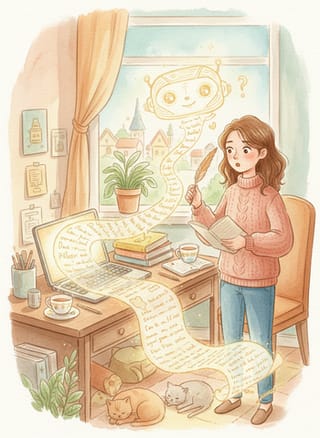
Adaeze had been staring at the same blank page for forty minutes when the kettle clicked off behind her. The request had arrived that morning, in a message from Gregor, who had worked on her team for three years before leaving in the spring.
He was applying for a post at a children's science museum, he wrote, and it was the job he had always dreamed of. Would she be willing to write him a glowing reference?
She should have refused at once, she told herself. Instead she had spent the whole day drafting sentences in her head.
Adaeze liked him. Everyone had. Gregor remembered birthdays, brought the good biscuits to meetings, and could calm an angry customer in under a minute.
However, he had also been late with nearly every report he ever handed in. Twice, a missed deadline had been quietly fixed by Adaeze herself, usually on a Sunday evening.
If she wrote the letter he wanted, she would be describing a person who did not exist. Words like "meticulous" and "outstanding" sat on the page like borrowed clothes.
Yet if she wrote exactly what she thought, he would probably never be invited to an interview. She knew how these letters were read. One lukewarm sentence could be enough to end a candidacy.
That evening she phoned her old mentor, who had been hiring people for thirty years. "Don't write what you wish were true," the mentor said. "Write what you would stake your name on. Then see how much there is."
Adaeze put the phone down and tried it. The first sentence was easy: Gregor was the best colleague she had ever known at making a nervous stranger feel welcome.
The second took longer. Then she remembered the laminated cards. In his second year, Gregor had made one for every regular client, listing their preferred delivery times and the name of their dog. Even after the system was replaced, the receptionists had kept using them.
She wrote about that. She also wrote, plainly, that he did his best work with a clear schedule and a partner who handled the paperwork. It was true, and it was exactly what a museum's visitor desk would offer.
Reading the letter back, she noticed that nothing in it was exaggerated, yet it was warm from the first line to the last. She sent it before she could add a single adjective.
Three weeks later Gregor phoned her, out of breath. "They quoted your letter to me," he said. "The part about the laminated cards. Then they asked whether I still had one I could bring on my first day."