The Nail
A free B1-level English story for language learners, readable online in 7 languages, with an option to listen via the free Storyteller app.
A merchant riding home with a bag of gold refuses to stop and fix a loose horseshoe nail — a small impatience that ends up costing him everything before he reaches home.
That was the preview! Hear the full story in the free Storyteller app. Get the app
Audio isn't available right now.
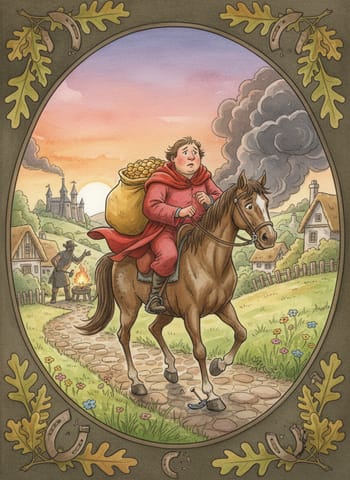
A merchant had been trading in a far city and had made much money, which he was now bringing home with him. He rode in haste, for he knew he would not feel easy until he had locked away the gold in his strong room at home.
Toward the middle of the morning he stopped at an inn to give his horse water. “Sir,” said the ostler who waited on him, “a nail is loose in your horse’s shoe.”
“No matter,” answered the merchant. “I am in haste, and the shoe must go as it is till I get home.”
A little later he stopped at another inn. “Sir,” said the ostler, “your horse’s shoe is loose; shall I not take him to the blacksmith near by and have the shoe fastened on?”
“No,” answered the merchant, “I have not time to wait. I must be home before nightfall.”
The merchant rode still farther, but presently his horse began to limp. It limped more and more, until at last, in the very midst of a deep forest, it stumbled and fell, and could not get up again.
The merchant was in despair. Dusk was coming on, and there seemed nothing for it but to spend the night in the forest. However, he discovered a house near by, and the old woman who was in charge of it promised him food and a lodging for the night.
When the merchant went up to bed he put his bag of gold under his pillow. He meant to watch all night, but he was very tired, and presently, in spite of himself his eyes closed and he fell into a deep sleep.
Now this house belonged to a band of robbers, and the old woman was their housekeeper. Soon after the merchant was asleep the robbers came home. The housekeeper told them of the rich man who had come to the house while they were away, and of how she had given him a bed for the night.
The robbers went up to the merchant’s room and finding him asleep they stole the bag of money from under his pillow, and made off with it.
In the morning, when the merchant awoke, he felt under his pillow for the bag, but it was gone. He called aloud, but no one answered. He searched the house from top to bottom, but could find nobody.
So the merchant lost both his gold and his horse. “And all,” said he, “because I was in such haste that I would not stop for a nail to be put in my horse’s shoe. It is a true saying—‘the more haste the less speed.’”