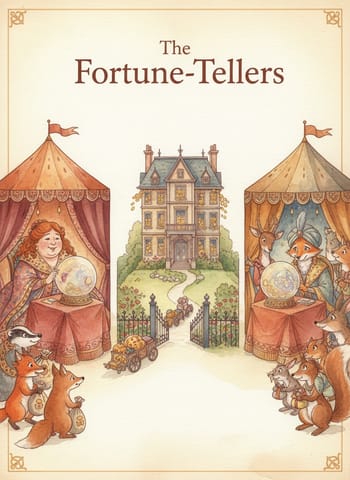
The Fortune-Tellers
A free B2-level English story for language learners, readable online in 7 languages, with an option to listen via the free Storyteller app.
A fraudulent fortune-teller becomes wealthy by fooling people who want to hear comforting lies — and her reputation proves so powerful that her successor profits too.
That was the preview! Hear the full story in the free Storyteller app. Get the app
Audio isn't available right now.
Reputations may be made by the merest chances, and yet reputations control the fashions. That is a little prologue that would fit the case of all sorts of people. Everywhere around one sees prejudices, scheming, and obtuseness; but little or no justice. Nothing can be done to stem this torrent of evil. It must run its course. It always has been and always will be.
A woman in Paris once made it her profession to tell fortunes. She became very popular and had great success. Did anybody lose a bit of finery; had any one a sweetheart; had any wife a husband she was tired of; any husband a jealous wife, to the prophetess such would run simply to be told the thing that it was comforting to hear.
The stock-in-trade of this fortune-teller consisted merely of a convincing manner, a few words of scientific jargon, a great deal of impudence, and much good luck. All these things together so impressed the people that as often as not they would cry, "Miraculous!" In short, although the woman's ignorance was quite twenty-three carat she passed for a veritable oracle.
Notwithstanding the fact that this oracle only lived in a garret, she found so many ready to pay her well for her shams that she soon grew rich enough to improve the position of her husband, to rent an office, and buy a house.
The garret being left empty was shortly tenanted by another woman to whom all the town—women, girls, valets, fine gentlemen—everybody in fact swarmed, as before, to consult their destiny. The former tenant had built up such a reputation that the garret was still a sibyl's den, in spite of the fact that quite a different creature dwelt in it.
"I tell fortunes? Surely you're joking! Why, gentlemen, I cannot read, and as for writing, I never learnt more than to make my mark." But these disclaimers were useless. People insisted on having their fortunes told, and she had to do it. In consequence, she put by plenty of money, being able to earn, in spite of herself, quite as much as two lawyers could. The poverty of her home was a help rather than a hindrance. Four broken chairs and a broom-handle savoured of a witch's frolic.
If this woman had told the truth in a room well-furnished she would have been scorned. The fashion for a garret had set in, and garret it must be.
In her new chambers the first fortune-teller waited in vain; for it was the outward sign alone that brought customers, and the sign was poverty.
I have seen in a palace a robe worn awry win much distinction and success, such crowds of followers and adherents did it draw. You may well ask me why!