The Echo over Calder Field
A free B2-level English story for language learners, readable online in 7 languages, with an option to listen via the free Storyteller app.
A field announcer finds that a borrowed microphone can measure the air above her, just when a pilot has to choose between two flights.
That was the preview! Hear the full story in the free Storyteller app. Get the app
Audio isn't available right now.
At five in the morning, Calder Field smelled of cut grass and cold metal. Fourteen balloons lay stretched across the meadow like sleeping animals, and the only light came from the gas burners of the crew testing their flames.
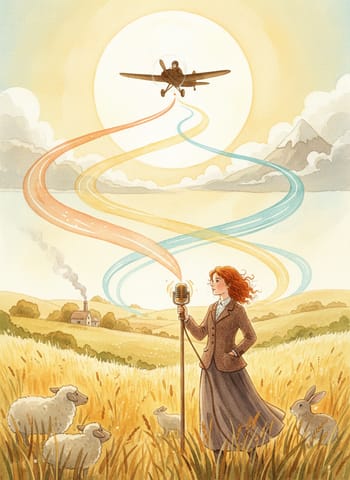
Nami stood on the announcer's platform with the microphone in both hands. It was not a normal microphone. The university had lent it to the field two months earlier, with a warning on a sticky label: PROTOTYPE. DO NOT DROP. DO NOT EXPLAIN TO VISITORS.
Every sound she made into it came back a few seconds later, thin and slightly bent, like a voice from the bottom of a well. The students called it the echo microphone. It was supposed to measure the layers of air above the field, and in the first week she had hated it.
"Good morning, pilots," she said now.
Good morning, pilots, said the sky, very faintly, six seconds later.
"That's a long one," said Verena, climbing the steps with a mug of coffee and a clipboard. She was the lead pilot of the field, a tall woman in a flight jacket. It had been repaired so often that it was mostly patches. "Yesterday it came back in four."
"It keeps rising," said Nami. "Six seconds up and down means something solid, about a kilometre over our heads. A sheet of warm air, sitting there like a lid. The students say it will vanish once the sun gets strong."
"Which is exactly my problem," said Verena.
She held out the clipboard. On it were two flight plans, and she had been carrying them around since midnight.
The first was the school flight. A class of fifteen-year-olds from the valley had spent a whole term building twelve tiny sensors, each the size of a matchbox. They wanted them lifted to the warm layer and dropped through it on small parachutes. It was the first real science many of them had ever done.
The second was the film flight. A small crew wanted to shoot the sunrise from a balloon basket for a documentary about the valley. Their payment would cover the field's insurance for half a year, and the producer had said, politely but firmly, that she could only come today.
"I have one balloon with enough lift for either," said Verena. "Both are good flights. Both people trusted me. I keep adding up the reasons, and the numbers never come out different."
"Then flip a coin," said Nami.
"I tried. I didn't like the result, so I flipped it again."
Nami laughed, and the laugh came back to them from the sky a moment later, small and strange. She looked at the clipboard, then at the microphone. A thought was forming, but she did not trust it yet.
"Give me ten minutes," she said. "I want to listen to something."
She turned the microphone toward the east, where the first pale line was opening over the hills, and spoke slowly into it. "Counting. One. Two. Three."
The echo returned. Counting, it said. One. Two. Three. Nami checked her watch and counted under her breath. Six seconds, then a little less. She waited a minute and repeated the test.
Five and a half.
She waited again, and the next echo returned in a little over five.
"Verena," she said quietly. "Come here and listen."
They stood together while she spoke into the microphone three times, each a few minutes apart. The delay was shortening every time. The layer was not simply sitting over the field. It was sinking toward the ground as the sun climbed and the lower air began to warm.
"How long?" said Verena.
"The students told me it would flatten out in about an hour. At this speed, I think it is less. Forty minutes, perhaps." Nami swallowed. "After that, there will be nothing to measure. And the film crew can fly again tomorrow. Can the students?"
Verena did not answer straight away. She looked at the clipboard and then at the hills, where the line of light had turned from grey to the colour of pale honey.
"No," she said. "Their sensors are built for one thing. A layer like this might not come again for weeks, and the class goes on holiday on Friday." She breathed out. "The film is good work. But a sunrise comes back every day, and this does not."
"So you have your answer."
"I have my answer," said Verena, and her whole body seemed to loosen. "I just needed somebody to hand me a reason I could not argue with."
She went down the steps two at a time and began shouting for the ground crew. Somebody ran to the van for the harness. Somebody else ran to find the school team, and for a while the whole field was moving in a hurry. Soon the school team arrived, still half asleep in their jackets, carrying the twelve sensors in a padded box. They had been so sure they would be refused that nobody had brought a camera.
Verena checked every sensor herself, one at a time, reading the small green numbers on each screen aloud. The students stood around her in a nervous half circle, and nobody dared to ask a single question until she finished. The producer was not happy when she was told. She nodded, however, when Verena offered her the first seat on tomorrow's flight, and she stayed to watch.
At twenty to six the burners roared. The envelope filled, trembled, and slowly stood upright against the pale sky. Two of the students climbed into the basket with their padded box, laughing nervously, and Verena took the controls with one hand on the cord. She lifted her other hand to Nami in a short wave.
Nami raised the microphone one last time. She did not make an announcement. She simply said, "Good luck," and listened.
The balloon rose, slowly at first and then with a steady, easy climb. It drifted over the fence, over the long line of poplars, and into the thin gold light. Its shadow slid across the meadow and disappeared. Soon it was only a small orange coin above the hills, getting smaller.
Nami held the microphone against her chest and waited. A few seconds later, from somewhere very high above the field, the sky said it back to her, as softly as a breath.
Good luck.