The Cancelled Exhibition
A free C1-level English story for language learners, readable online in 4 languages, with an option to listen via the free Storyteller app.
A gallery curator who learns that an artist's "handmade" prints were largely generated by software must decide what honesty requires.
That was the preview! Hear the full story in the free Storyteller app. Get the app
Audio isn't available right now.
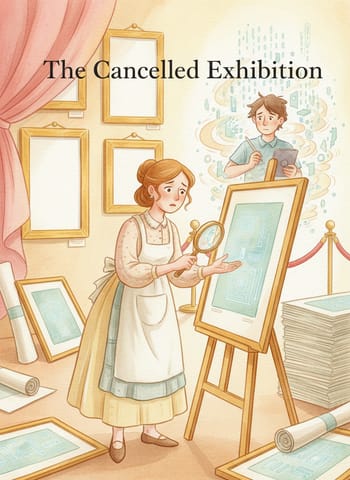
The first thing Olav noticed was a hair. It lay in the lower left corner of a print called Salt Field, No. 4, a tiny curved line in the ink that he took, on Tuesday morning, for the signature of a human hand. By Wednesday he had found the same curve in the same corner of seven other prints. A hand does not make the same mistake eight times. A file does.
The gallery occupied two rooms above a bakery, and the exhibition was due to open in nine days. Olav had written the wall labels himself, from the artist's own catalogue notes: hand-cut linocut, hand-printed, edition of twenty. He had been proud of them. Having spent a decade persuading visitors that a slightly wobbly line was worth three times a perfect one, he had come to treat the word handmade as close to a promise.
That evening he opened the folder Damaris had emailed in the spring and looked at the file names properly for the first time. Salt_Field_v47_final2. Next to each sat a small settings file from a piece of software, with the word generated in a line he had never scrolled down to. Rarely had he felt so politely deceived.
She came to the gallery the next morning, carrying her portfolio under one arm like a shield. She did not deny it. "The compositions are generated," she said. "I give the software a direction and a set of rules, and it makes thousands of variations. I choose. I change things. A machine cuts the blocks. And I print every sheet myself, with a roller and my own two hands."
"The labels say handmade."
"I never told you to write handmade."
"You never told me not to."
"My hands pulled every one of those prints."
"Your hands pulled them," Olav said. "A program drew them."
Damaris set the portfolio down. "Is a photographer's picture less hers because a lens does the drawing?"
"Nobody tells people a photograph is a painting." He heard his own voice, tighter than he wanted. "That's the whole difference. I have no objection to software. What I cannot do is let a stranger stand in front of these and believe they are looking at hours of cutting that never happened."
"Some of them will walk away."
"Then those are the ones who most deserve to know."
She looked at him for a long moment. "And what would you have said," she asked, "if I had told you in the first meeting?"
It was a fair question, and an uncomfortable one. Had she simply said so, he would have hung the show without a second thought, and probably with pleasure; the prints were beautiful, whatever else they were. It was the silence he could not forgive, not the software. Even so, he was not certain the silence had been entirely hers. He had never asked.
That night, in a voice he hoped sounded fair, he wrote the cancellation email to the printer, the press list and the two sponsors. He read it twice. He did not send it.
At nine the next morning he asked her back. On the desk between them lay a single sheet of card, freshly printed.
"Software-generated compositions," Damaris read aloud, slowly. "Selected, edited and hand-printed by the artist."
"It will go beside every piece. Bigger than the title, if you want."
"It's less beautiful," she said.
"It's more accurate."
"Those aren't the same thing."
"I know," Olav said, and held out a pen.