The Unmentioned Sketchbook
A free C1-level English story for language learners, readable online in English, with an option to listen via the free Storyteller app.
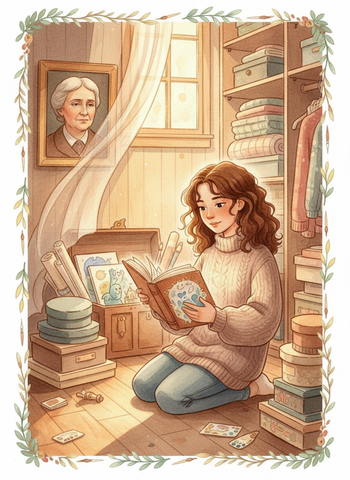
Packing up her dismissive grandmother's closet, a teenage artist finds a hidden sketchbook that reveals why her grandmother always discouraged art.
Marnie's grandmother Agnes had never once said a kind word about the portfolio Marnie was building for art school, calling it, more than once, "a nice hobby for someone with a real plan B."
Marnie had learned to stop showing Agnes new work months ago, tired of watching real enthusiasm curdle into polite, distancing comments the moment a piece was finished. It was easier, she had decided, to simply keep that part of her life somewhere Agnes couldn't reach it.
Agnes broke her hip and moved in with Marnie's parents for recovery. So it was strange, packing up her closet, to find a sketchbook wedged behind a stack of winter coats, its spine cracked from age rather than use.
Inside were drawings Marnie recognized immediately as genuinely good: careful studies of hands, and of the same tree from six different angles across what must have been several seasons. There was also a self-portrait, dated on the inside cover to a year that would have made Agnes seventeen.
Had Marnie not broken her own rule and shown Agnes anything that week, she might never have mentioned finding it at all. Instead, unable to stop herself, she brought the sketchbook to her grandmother's temporary bedroom and set it, without a word, on the blanket across her lap.
Agnes went quiet for longer than Marnie had ever seen her go quiet, turning pages slowly, her expression somewhere between recognition and something closer to grief.
"I was going to apply," Agnes finally said. "To a program, in the city. My mother needed help at home instead, and by the time she didn't, I'd already stopped thinking of myself as someone who drew."
"You never told anyone this existed."
"What was there to tell? I stopped. People who stop don't usually bring it up."
What surprised Marnie most was not the sketchbook itself but a sudden, uncomfortable recognition. She realized where Agnes's discouragement had actually been coming from all along: not indifference, and certainly not malice, but an old, carefully buried grief dressed up as practical advice.
"Is that why you always said art wasn't a real plan?" Marnie asked, quieter than she meant to.
Agnes didn't answer directly. "I didn't want you disappointed the way I was," she said eventually. "I'm starting to think I did it badly."
This did not resolve into forgiveness in one conversation, nor into Agnes suddenly championing Marnie's portfolio the way Marnie might once have wished. What it did was quieter and more complicated. Marnie began to see her grandmother's discouragement as a warning shaped by real loss rather than simple disapproval. That made it easier to hear, and, somehow, harder to fully forgive, at the same time.
She kept building her portfolio anyway. She also kept the old sketchbook, eventually, in a drawer of her own, unsure which of them it now actually belonged to.
