The Sensor Street
A free C1-level English story for language learners, readable online in 4 languages, with an option to listen via the free Storyteller app.
When a city pilot turns their lane into a street of sensors, the neighbours argue over privacy and convenience at a meeting that reveals who they all are.
That was the preview! Hear the full story in the free Storyteller app. Get the app
Audio isn't available right now.
The notice arrives in every letterbox on the same Monday, printed on paper thick enough to suggest that someone at the council has been rewarded for it. Cranmore Lane, a hundred and forty metres of terraced houses, one bakery and one shuttered chemist, has been selected as the city's first "responsive street." Over the next quarter, the lampposts will be fitted with sensors that measure traffic, noise and footfall, and the data will, the notice promises, be "anonymised, aggregated and used to improve everyday life." Sten reads the last phrase twice. He has lived on the lane for nineteen years and cannot think of anything about everyday life that needs improving, except possibly the lamp outside number nine, which has flickered since spring.
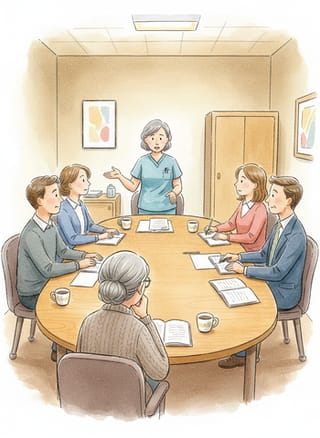
The residents' meeting takes place in the back room of the bakery, where the chairs have been borrowed from a church and nobody agrees on how to arrange them. Rita, who runs the lane's recycling rota with a tenderness bordering on cruelty, is first on her feet. "I want to know who owns the numbers," she says. "Not who collects them. Who owns them." A young man from the council, holding a tablet like a shield, replies that the data belongs to the public, and Rita says that this is precisely what she is afraid of.
Mona speaks next, and the room, which has been murmuring, settles. She is eighty-one and lives alone at number nine. "Last February I fell on the ice at half past six in the morning," she says, "and I lay there for forty minutes, on a street I have lived on for fifty years. If a lamp had known I was there, I would have been very glad of a lamp that knew." Nobody answers at once, and in the silence Sten becomes aware of how many of his neighbours are studying their own hands.
The argument that follows is less about sensors than about the street itself. The baker wants the footfall figures, quite openly, to show his landlord that the shop is busy. A couple with a baby want the noise readings to stay low, and the man who plays the trumpet at number twenty-two would prefer that they did not exist. Somebody asks whether the sensors can hear voices. The council man says no, a little too quickly, and then says he will find out, which is worse.
Sten, who came intending to object, discovers that he cannot say what he objects to. Having spent most of his working life as a surveyor, he knows exactly what it is to measure a place: the odd intimacy of it, the way figures flatten a house into a list. What troubles him is not that the lane will be counted but that it will be counted accurately, and that the count will become the version of the street that matters. If the sensors had arrived twenty years earlier, he thinks, they would have recorded a very different lane, one with children on the pavement until dark, and nobody would have thought to mourn the difference.
The vote is taken by a show of hands, which seems to him the most old-fashioned and therefore the most reassuring part of the evening. Eleven are in favour, nine against, four abstaining, Rita among them; she explains, scowling, that she wants the data to exist so that she can keep checking it. Sten abstains too, and is surprised by how much the gesture feels like a decision.
He walks home at ten, past the bakery's dark window, past the lamppost outside number nine, which the council man has already marked with a small yellow sticker. Rarely has he looked at one so carefully. It is an ordinary lamp, flickering a little, utterly indifferent. He stops beneath it, puts his hands in his pockets and stands perfectly still, curious to learn whether a street that is about to count him can tell, in the end, that he is there.