The Plated Credit
A free C1-level English story for language learners, readable online in English, with an option to listen via the free Storyteller app.
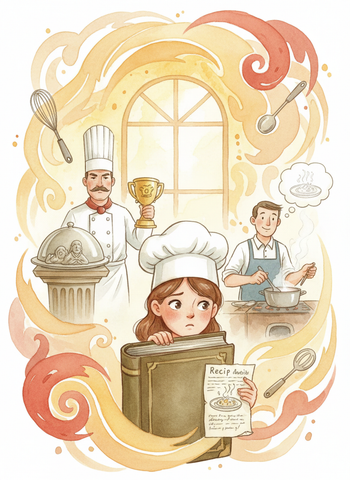
A culinary-arts intern finds proof that her mentor's signature dish was invented by a line cook who never got credit for it, and has to decide whether to speak up days before a career-making showcase.
Marisela had spent three months believing that Chef Rutger Duarte's signature dish, a charred leek risotto he called "Ash and Cream," was entirely his own invention. That was the story he told every table that asked. Then, while reorganizing the walk-in's overflow shelf on a slow Tuesday, she found a spiral notebook behind a crate of parmesan, its pages filled with handwriting that clearly wasn't his.
The recipe inside, dated two years earlier, was unmistakably the same dish, down to the exact ratio of smoked butter to stock. What stopped her cold was the name signed at the bottom of the page: Yeva. She was the line cook people still mentioned in passing, the one who had gone home before her visa renewed and never come back. Not once, in three months of prep talks and plating lessons, had Duarte mentioned that the dish wasn't his.
Marisela told herself, at first, that it didn't matter. Chefs borrowed from each other constantly, and a kitchen ran on inherited technique; crediting every influence would make any menu unreadable. Had she found the notebook a week earlier, before the regional showcase was even scheduled, she might have let the whole question fade quietly, the way most kitchen grudges did.
But the showcase was in four days, and Duarte planned to serve "Ash and Cream" to three judges from the culinary board, one of whom was reportedly already drafting a feature article. It was that detail, more than the borrowing itself, that made the notebook impossible to simply put back.
She practiced the conversation for two days, rehearsing gentler versions and blunter ones. What finally decided her wasn't outrage on Yeva's behalf, exactly, but something closer to a private test. If she stayed silent now, she doubted she would ever again trust her own judgment about what a kitchen owed the people who passed through it.
She found Duarte alone in the office before service, counting the register, and set the notebook on the desk without any introduction. He looked at it for a long moment before asking, quietly, how long she'd had it.
"Two days," she said. "I wanted to be sure it was what I thought it was."
He didn't deny it, which she hadn't expected. Instead he asked what she wanted him to do, and she realized, with some discomfort, that she hadn't actually prepared an answer to that part.
"Put her name on the menu," Marisela said. "Just that. You can still cook it."
Duarte was quiet long enough that she assumed he would refuse. Rarely had she seen him so still, his hands flat on either side of the notebook as though it might otherwise slide away from him. Then he nodded once, picked the notebook up, and told her to get her knives — service started in twenty minutes, and the leeks weren't going to char themselves.
She left the office without knowing whether the showcase menu would actually change. But she plated her station that night with a steadiness she hadn't quite earned yet. For the first time all internship, the dish under her hands felt like it belonged to someone whose name she now knew.
